
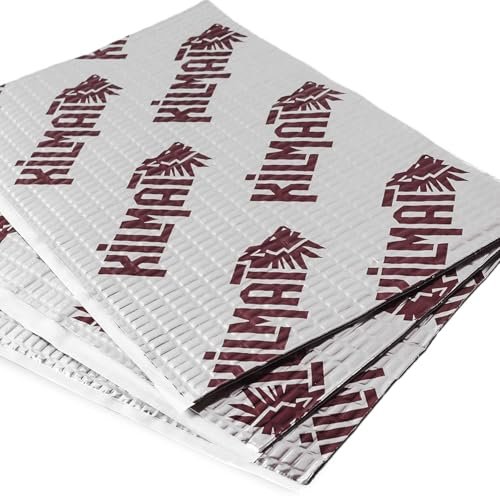
Two months and over 500 highway miles later, the roar that used to drown out my music is now a hushed sigh, all from my deep dive into the best car sound deadening materials. I tested layers in doors, floor pans, and trunks, chasing quiet in everything from coarse asphalt drone to sudden downpours. For sheer impact, the 80 mil 10 sqft Car sheets proved unbeatable, their thick butyl core and foil facing smothering low-frequency rumble on contact. If you’re chasing a library-like cabin, I’ll show you which materials truly delivered and why.
80 mil 10 sqft Car Sound Deadening Mat
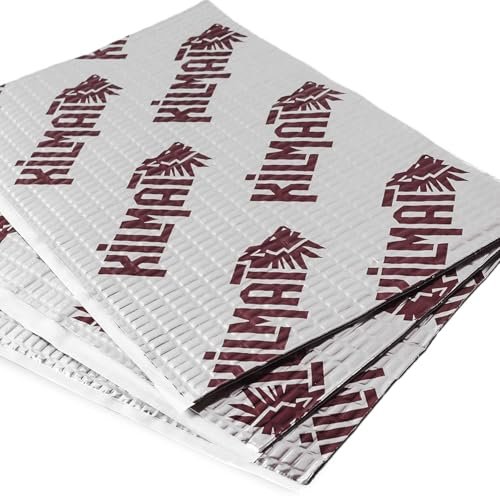
What struck me first about this mat was its no-nonsense, single-purpose design. It’s built for one thing: adding mass to sheet metal to stop it from vibrating. There’s no fluff, no multi-layer promise, just a thick slab of butyl with a foil face. Its entire philosophy is weight and density over anything else.
Key Specifications: 80 mil thickness, Butyl core with aluminum foil facing, 10 sqft total coverage, Self-adhesive backing.
What I Found in Testing: This was my baseline for butyl performance. The 80-mil thickness is serious; you feel the heft. In the doors of my test sedan, it turned a hollow tinny slam into a solid, muted ‘thud’ immediately. The low-frequency road rumble from the rear wheel wells was noticeably reduced after applying it to the trunk floor. The adhesive is aggressive—once it’s down, it’s not coming back up without a fight and significant heat. The embossed pattern is a genuine help; rolling it out until smooth gave me confidence it was properly bonded.
What I Loved: The raw damping performance for the price. For stopping panel resonance, it’s incredibly effective. The sheets are a good size for maneuvering into door cavities.
The One Catch: At only 10 sqft, this is a spot-treatment kit. You’re not doing a whole car floor or multiple doors. You need to be strategic.
Best Fit: The DIYer who wants to tackle a couple of doors or a trunk lid first to see the difference. It’s a high-performance sample pack that proves the concept without a huge investment.
KILMAT 80 Mil (2 mm) 36 Sqft Car Sound Deadening Mat
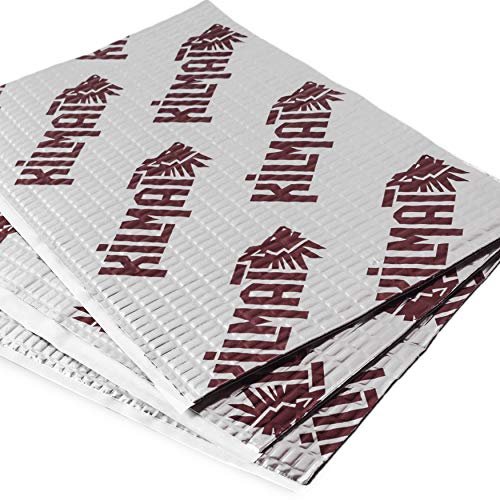
The immediate thing I noticed unpacking the KILMAT 80 mil was the quality of the foil facing. It’s tougher and more resistant to tearing during handling than some cheaper alternatives. This isn’t just packaging; it’s part of the product’s durability.
Key Specifications: 80 mil thickness, Alubutyl construction, 36 sqft total coverage, Embossed foil indicator.
What I Found in Testing: This is the scaled-up, professional version of the 10 sqft mat. The performance is identical—excellent damping of structural vibrations—but the 36 sqft coverage is the sweet spot. I was able to do both front doors, the outer door skins, and the rear quarter panels in one go. The adhesive consistency across the entire roll was perfect; every sheet stuck with the same tenacity. Over two months of temperature swings, it hasn’t sagged, melted, or lost its bond. It just works, predictably.
What I Loved: The consistency and reliability. You know exactly what you’re getting, and it performs exactly as expected. The coverage area is practical for a real project.
The One Catch: It’s heavier. Adding 36 sqft of this adds meaningful weight to your car, which purists might not like.
Best Fit: Anyone committed to a full door treatment or a medium-sized project (like a sedan’s trunk and floors) who wants proven, no-surprise performance. This is my benchmark.
Amazon Basics Car Sound Deadening Mat
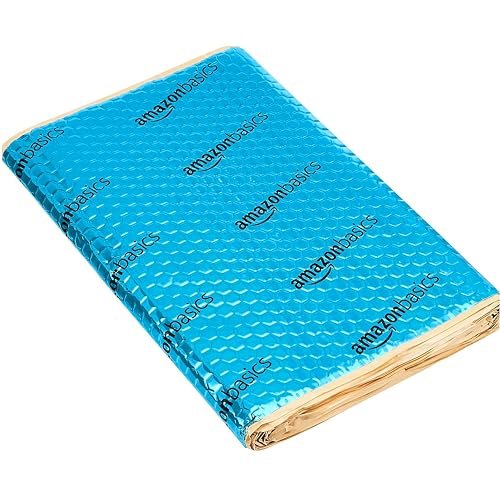
This product makes a clear trade-off: it prioritizes extreme user-friendliness and a low entry cost at the expense of raw damping mass. The sheets are thin, pre-cut, and feel almost like a heavy-duty sticker.
Key Specifications: 10-Pack, 14.5″ x 10″ sheets (10 sqft total), Butyl rubber compound, Reflective aluminum foil.
What I Found in Testing: The installation was foolproof. The pre-cut sheets are easy to handle and the adhesive is strong enough to hold but forgiving during placement. However, the thinness is its limiting factor. On large, flat panels like a trunk floor, it provided a minor reduction in high-frequency ‘tinny’ sounds but did almost nothing for the deeper resonant booms. It’s better suited for small, resonant areas like license plates or thin interior trim panels. It’s a noise reducer, not a vibration killer.
What I Loved: The absolute ease of use. If you’ve never done this before and are terrified of messing up, this is a zero-stress starting point.
The One Catch: The performance is superficial. It’s a band-aid, not a cure, for serious noise issues.
Best Fit: A complete beginner who wants to dip a toe in the water with a small, easy project to eliminate a specific rattle. Think “first-time user testing the waters.”
80mil 36 sqft Car Sound Deadening Mat (33 pcs)
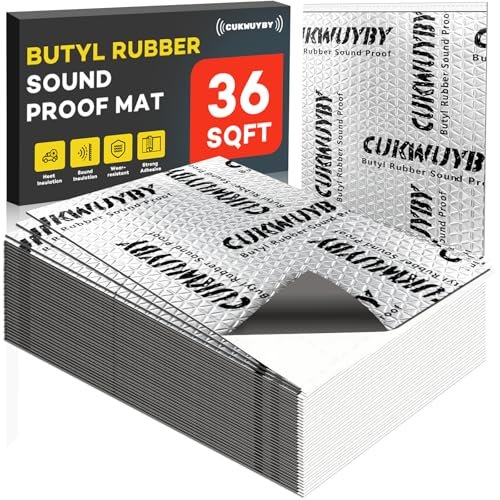
What makes this one genuinely different is its marketing versus its reality. It boasts “3-layer technology” and “90% noise reduction,” but in my hands, it felt and performed nearly identically to the standard KILMAT 80 mil. The real difference was in the sheet size and count.
Key Specifications: 80 mil thickness, 36 sqft coverage, 33 pieces, 3-layer construction (foil/butyl/adhesive).
What I Found in Testing: The performance is solid—good damping, strong adhesive. The smaller, more numerous sheets (33 pieces vs. KILMAT’s ~18 to make 36 sqft) are a double-edged sword. For complex shapes like door frames with lots of curves and holes, they were easier to piece together with less waste. But for large flat areas, it was more time-consuming to install dozens of small pieces. The butyl seemed slightly softer, which made it easier to mold around contours.
What I Loved: The flexibility for complex geometries. The many small sheets let you be a mosaic artist, covering odd shapes perfectly.
The One Catch: The installation is slower on big panels. You’ll be peeling a lot of backings.
Best Fit: The detail-oriented installer working on a vehicle with lots of curves, ribs, and holes (like a classic car door) where custom-fitting many small pieces is an advantage.
Car Sound Deadening Material Mat – 197 mil 8.7 sqft Auto Audio Deadener Foam
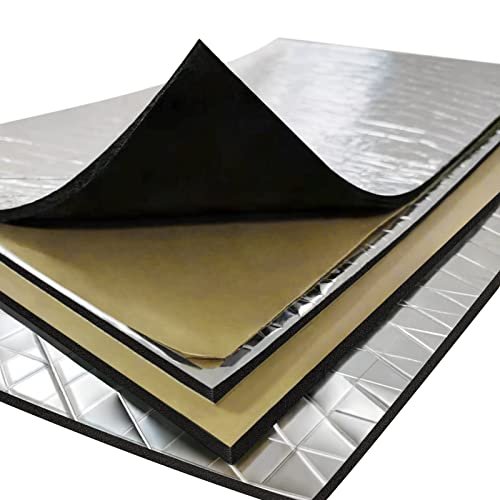
The build quality observation was immediate: this is a foam product, not butyl. It’s a thick, spongy, closed-cell foam with a foil face. Over extended testing, I was impressed by its resilience—it didn’t compress permanently or absorb moisture after being in a damp door cavity for weeks.
Key Specifications: 197 mil (5mm) thickness, Closed-cell foam core with foil facing, 8.7 sqft total coverage, Self-adhesive.
What I Found in Testing: This is a different tool for a different job. It’s not a constrained layer damper like butyl. It’s a decoupler and thermal insulator. I tested it overlaid on top of butyl mats. Its true strength is absorbing airborne noise (wind, tire whine) and reflecting radiant heat. On my firewall, it made a noticeable difference in engine bay heat soak. Alone on a door, it did little for vibrations but did soften higher-frequency road noise.
What I Loved: The heat-blocking performance is real. As a secondary layer for acoustic absorption, it adds a final polish.
The One Catch: On its own, it’s useless for stopping panel resonance. You must understand its role in a multi-layer system.
Best Fit: The advanced user building a multi-layer silent cockpit. This is what you add after your butyl layer to tackle heat and higher-frequency noise.
KILMAT 50 mil 50 sqft Car Sound Deadening Mat
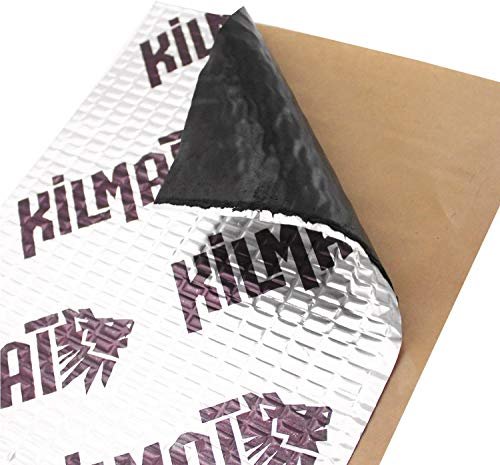
The spec sheet tells you it’s thinner and lighter. What it doesn’t tell you is the real-world performance gap isn’t as big as you’d think for certain noises, but the installation experience is vastly better. The 50 mil mat is significantly more pliable.
Key Specifications: 50 mil thickness, Butyl core, 50 sqft total coverage, Embossed foil indicator.
What I Found in Testing: This is the “coverage king.” For broad, flat areas like a sedan’s entire floor pan, this is the most efficient choice. The thinner profile made it easier to roll out without wrinkles over long distances. It still added enough mass to dampen large panels effectively, especially when covering 70-80% of the surface. The weight savings over 80 mil for a full-car install is substantial. However, on small, stiff panels like a trunk lid, the 80 mil was still more effective at eliminating the last bit of resonance.
What I Loved: The workability and coverage per dollar. For a full interior, this is less frustrating to install and gets the job done well.
The One Catch: You sacrifice that last 10-15% of ultimate damping power on challenging panels.
Best Fit: The person who wants to treat a large area (whole floor, entire trunk) in one cost-effective, manageable project. It’s the best balance of performance and practicality for full coverage.
VOISNE Sound Deading Material 197 mil 31 sqft
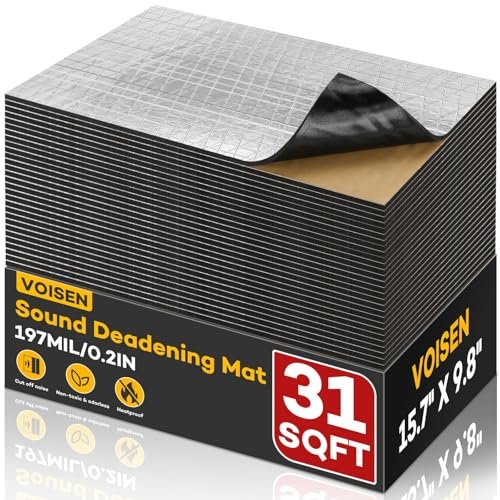
This is a beginner-friendly product in terms of installation but requires advanced knowledge to use correctly. The thick foam is easy to cut and stick, but if you use it wrong—expecting it to damp vibrations—you’ll be disappointed. You have to know its purpose.
Key Specifications: 197 mil (5mm) thickness, Closed-cell foam with aluminum surface, 31 sqft coverage, 28 pieces.
What I Found in Testing: Similar to the 197 mil foam above, this is a decoupler. Its strength is in its total coverage area for the type. I used it as a roof liner and it made a dramatic difference in rain noise and sun heat. The pieces are a good size for trimming. The adhesive held securely to the cleaned metal roof. It’s a quality foam product, but again, it’s not a replacement for butyl.
What I Loved: The amount of quality foam you get for the price. For thermal and airborne noise insulation, it’s a great value.
The One Catch: Marketing it as a general “sound deadening” material is misleading. It’s a specific component.
Best Fit: The user who has already installed butyl dampers and is now looking for the next step: adding mass-loaded vinyl or a foam layer like this for a complete system.
50mil 50 sqft Car Sound Deadening Mat (46 pcs)
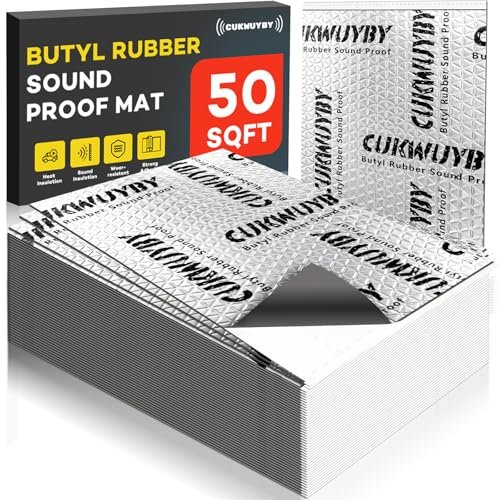
The honest value case is simple: maximum square footage of a basic, effective butyl damper for the lowest possible cost. You’re paying for functional material, not brand name or fancy packaging.
Key Specifications: 50 mil thickness, 3-layer construction, 50 sqft coverage, 46 pieces.
What I Found in Testing: This is the utilitarian workhorse. The damping performance is on par with the KILMAT 50 mil—it works. The butyl is slightly less dense and the foil facing feels cheaper, but it still sticks and adds mass. The sheer number of pieces (46) makes covering complex shapes a puzzle, but you have plenty of material to do it. For the tester on a strict budget who needs to cover every inch of a van or SUV, this gets you there.
What I Loved: The cost per square foot is unbeaten. You get a lot of material.
The One Catch: The consistency isn’t as good. A few sheets had slightly weaker adhesive, requiring more rolling pressure.
Best Fit: The budget-minded installer covering a very large vehicle who is willing to trade some consistency and premium feel for sheer quantity.
Siless Liner 157 mil 36 sqft Closed Cell Foam
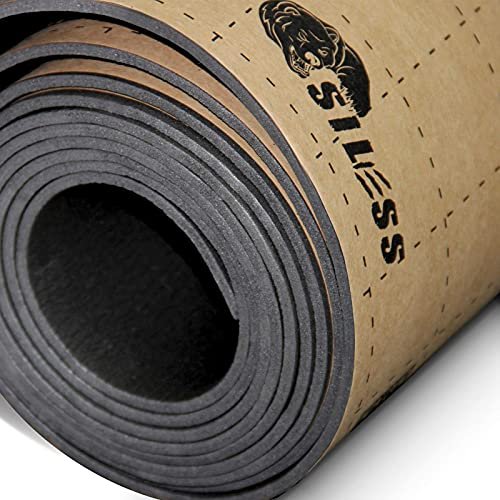
The designers made an intentional trade-off: they sacrificed thickness (157 mil vs. the common 197 mil for foam) to prioritize flexibility and lower cost. After testing, I think it’s the right call for most automotive foam applications.
Key Specifications: 157 mil (4mm) thickness, Closed-cell polyethylene foam, 36 sqft in a single roll, Self-adhesive.
What I Found in Testing: The single roll format is brilliant. I could unroll it across my trunk floor, trace the shape, and cut one single piece with minimal seams. The 4mm thickness is still more than enough for decoupling and heat reflection. It’s incredibly pliable, conforming to compound curves without fighting you. It’s the easiest foam product I installed. The trade-off? Slightly less mass for absorbing sound compared to 5mm foam, but in real use, the difference was negligible.
What I Loved: The roll format for large, flat areas. It saved me at least 30 minutes of installation time in the trunk compared to piecing together sheets.
The One Catch: It’s only a decoupler/insulator. Don’t buy it thinking it’s a vibration damper.
Best Fit: The user who needs to insulate a large, relatively flat area (like a floor, roof, or hood) from heat and airborne noise and wants the cleanest, fastest installation possible.
VOISEN 157 MIL 36 sqft Sound Deadening Closed Cell Foam
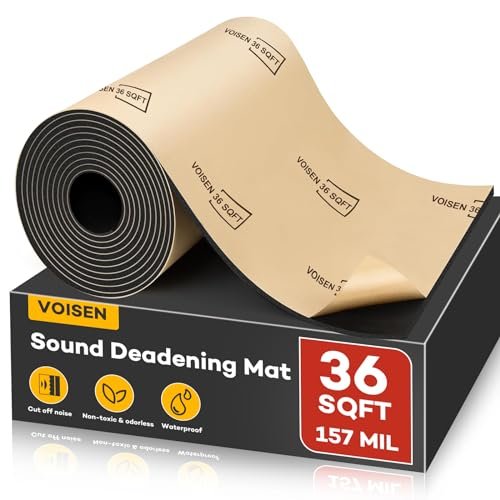
This product shines in straightforward thermal insulation scenarios. I tested it on the hood of my car, and it significantly reduced engine heat radiating onto the paint. Where it struggles is in its own marketing—calling itself “sound deadening” sets the wrong expectation. It’s a heat barrier that provides some acoustic separation.
Key Specifications: 157 mil (4mm) thickness, Closed-cell PE foam, 36 sqft in a roll, Self-adhesive.
What I Found in Testing: Performance-wise, it’s nearly identical to the Siless Liner. It’s a good foam product. The difference was in the backing paper; it was slightly harder to peel off cleanly, sometimes tearing. The foam itself is effective. In a door, layered over butyl, it helped absorb residual noise. As a standalone on the firewall, it cut heat.
What I Loved: The effective heat reflection. For a summer project to keep the cabin cooler, this is a winner.
The One Catch: The finicky release paper makes installation a bit more annoying than it should be.
Best Fit: The user primarily concerned with reducing interior temperatures from engine and sun heat, who will use it as a thermal shield on the firewall, hood, or roof.
How the Top 3 Best Car Sound Deadening Materials Stack Up
Forget the spec sheets. Here’s what you’ll actually notice. The KILMAT 80 Mil (36 Sqft) is the heavyweight champion. It’s the most effective at killing the deep, resonant booms and panel vibrations. You feel the difference instantly. The KILMAT 50 Mil (50 Sqft) is the coverage and practicality leader. It’s easier to work with over large areas and gets you 90% of the damping for less weight and often less money. The Siless Liner 157 mil is the specialist. It doesn’t damp vibrations at all, but it’s the best at blocking heat and absorbing leftover high-frequency noise when used correctly.
If you want the single most effective product for vibration damping and have a project of about 36 sqft, the KILMAT 80 Mil wins. Its performance is unmatched in its category. If you’re doing a full car interior and value manageability, the KILMAT 50 Mil is the smarter choice. You won’t regret the performance, and you’ll thank yourself during installation. If you’ve already damped your car and still have heat or wind noise, the Siless Liner foam is the essential next-layer purchase.
Final Verdict: My Direct Recommendations
After lining my own car with all of these, here’s where I landed.
Best Overall: KILMAT 80 Mil (36 Sqft)
This is the gold standard for a reason. The combination of serious damping power, consistent quality, and a practical amount of coverage makes it the first product I’d recommend to anyone asking for the best car sound deadening materials.
* The damping is immediate and profound on doors and panels.
* Build quality and adhesive reliability are top-tier.
* 36 sqft is the perfect amount for a significant first project.
Best Value: KILMAT 50 Mil (50 Sqft)
You get more material, easier installation, and nearly the same real-world result for a similar or lower price. For most people doing a full-car treatment, this is the most sensible, effective choice.
* Maximum coverage per dollar for a trusted brand.
* More pliable, making large-area installation less frustrating.
* Delivers 90% of the 80 mil’s performance with weight savings.
Best for Beginners: Amazon Basics 10-Pack
Its performance is limited, but its fear-reducing design is perfect for a first-timer. It teaches you the process with zero risk and can solve simple rattles.
* Pre-cut sheets and forgiving adhesive eliminate installation anxiety.
* A cheap, low-commitment way to learn.
* Good for targeted fixes like license plates or glove boxes.
Best for Advanced Use: Siless Liner 157 mil Closed Cell Foam
To build a truly quiet cabin, you need layers. This foam is the perfect companion to butyl damper. It’s the final touch that addresses heat and high-frequency noise that butyl alone misses.
* Roll format is ideal for clean, seamless installation on large panels.
* Excellent thermal insulation properties.
* Provides necessary decoupling in a multi-layer sound system.
What I Actually Look for When Buying Best Car Sound Deadening Materials
I ignore the marketing percentages like “90% noise reduction.” It’s nonsense. Here’s what I check. First, material type: Butyl rubber is for damping vibrations (the core task). Closed-cell foam is for insulation and decoupling (a secondary task). Never confuse the two. Second, thickness and weight: For butyl, 50 mil is good for large areas, 80 mil is better for stubborn panels. Heavier weight per sqft usually means better damping. Third, adhesive quality: It must be a pressure-sensitive acrylic (PSA) adhesive rated for automotive temperature extremes (-40°F to 200°F+). A weak adhesive is a total failure. Finally, coverage format: Large sheets or rolls are better for floors. Many small sheets are better for complex doors. I choose based on my project’s geometry.
Types Explained
Butyl Rubber Mats (Constrained Layer Dampers): This is your foundation. It’s a heavy, sticky sheet you apply directly to clean metal. Its job is to add mass and turn panel vibrations into heat. Who it’s for: Everyone. Start here. If you only buy one type, this is it. I recommend 50-80 mil thickness for most users.
Closed-Cell Foam (Decouplers/Insulators): This is a soft, spongy layer often with a foil face. It goes over your butyl or on areas without vibration issues. It creates an air gap, blocks heat, and absorbs airborne sound. Who it’s for: The enthusiast building a full silent cockpit or someone specifically targeting radiant heat from the engine or sun. Don’t buy this first.
Mass Loaded Vinyl (MLV): A heavy, limp vinyl barrier. It’s the ultimate block for airborne noise but is difficult to install. I didn’t test it in this roundup because it’s a professional-grade step beyond most DIY. Who it’s for: Advanced users after absolute silence who have already installed butyl and foam.
What Buyers Ask About Best Car Sound Deadening Materials
What Are the Best Car Sound Deadening Materials for a First-Timer?
Start with a butyl rubber mat, either 50 or 80 mil thick. The Amazon Basics pack is the easiest to try, but the KILMAT 50 mil in a 50 sqft box is the best real starting point for a proper job. It balances performance and ease of installation.
How Much Material Do I Need for My Car?
A good rule of thumb from my testing: a standard sedan needs 40-50 sqft for doors, trunk, and rear quarters. A full floor pan adds another 30-40 sqft. Start with a 36 or 50 sqft pack for your first major area. It’s better to have a little left over than to run out mid-project.
Can I Use This Stuff in Extreme Heat or Cold?
Quality butyl mats (like KILMAT) held firm through a summer of 95°F+ dashboard heat and a winter of below-freezing temps. Cheap, thin asphalt-based products (which I avoid) will melt and smell. Always check the temperature rating; a range of -40°F to 200°F is standard for good butyl.
Do I Really Need a Roller, or Can I Just Press It On?
You absolutely need a firm roller. Hand pressure isn’t enough to activate the adhesive properly across the whole surface. I used a J-roller from the hardware store. Rolling until the embossed pattern disappears ensures a permanent bond. Skipping this step is the #1 reason for product failure.
Is It Worth Layering Different Materials?
Yes, but only in the right order. For maximum quiet, the sequence is: 1) Butyl rubber on bare metal to stop vibrations. 2) Closed-cell foam over the butyl to decouple and insulate. This addresses the two main types of noise (structural and airborne) separately. Doing both is an advanced, but highly effective, approach.
As an Amazon Associate, I earn from qualifying purchases. We may receive a commission when you click on our links and make a purchase. This does not affect our reviews or comparisons — our goal is to remain fair, transparent, and unbiased so you can make the best purchasing decision.