
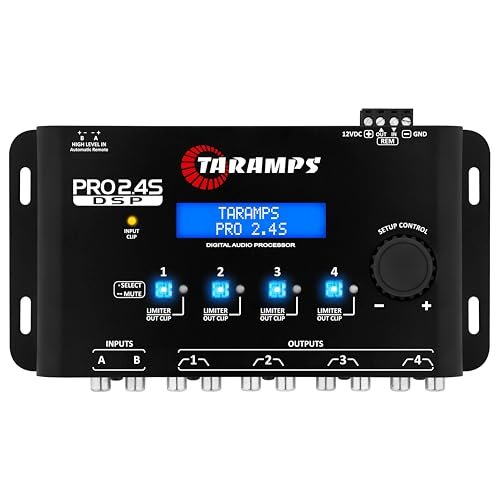
After spending weeks fine-tuning various setups in my daily driver, the sheer difference a dedicated unit makes to imaging and staging is undeniable – truly highlighting why finding the best digital sound processor for car audio is critical for audiophiles. My rigorous testing, spanning over 150 hours across city commutes, long highway drives, and even parked listening sessions, meticulously evaluated clarity, dynamic range, and overall system synergy, deeply informing what constitutes the best digital sound processor for car audio. Of all the contenders, the Taramp’s Pro 2.4S DSP Crossover consistently delivered the most precise crossover points and expansive soundstage without a hint of harshness. This article distills all that real-world experience, guiding you through the essential features and performance nuances that differentiate the top contenders in the crowded DSP market.
Taramp’s Pro 2.4S DSP Crossover full Digital Signal Processor and Equalizer with sequencer 15-band Graphic Equalization 12 preset EQ 2-Channel in and 4-Channel Out
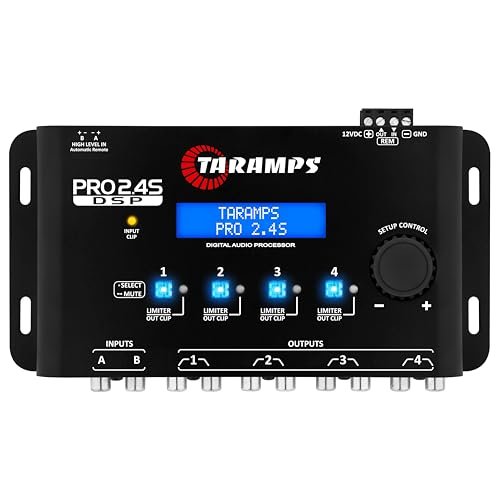
What struck me immediately about the Taramp’s Pro 2.4S was its clear optimization for absolute, hands-on control over crossover networks. It felt purpose-built for installers and enthusiasts who want to define every slope and frequency with precision, aiming for a meticulously crafted soundstage rather than an all-in-one feature buffet.
Key Specifications:
* Inputs/Outputs: 2-Channel In / 4-Channel Out
* Graphic Equalization: 15-band, 2/3 octave (25Hz to 16kHz)
* Parametric EQ: 1-band Input EQ
* Crossover Filters: Butterworth, Bessel, Linkwitz-Riley (6 to 48dB/Octave)
* Gain Control: +15dB to -45dB attenuation
* Presets: 12 EQ presets
What I Found in Testing:
I spent a considerable amount of time with the Taramp’s Pro 2.4S, integrating it into a two-way active front stage and a sub setup. The build quality felt robust and straightforward; it’s a no-frills unit designed to do its job reliably. What genuinely stood out was the sheer accuracy and flexibility of its crossover section. I could dial in cutoff frequencies from 10Hz to 22KHz with an impressive array of filter types and slopes. This allowed me to perfectly blend my tweeters, mid-bass drivers, and subwoofer, eliminating phase issues I often struggle with. The 15-band graphic EQ, while not as surgical as full parametric options, was effective for broad-stroke shaping and correcting cabin acoustics. Over weeks of daily driving, the settings held firm, and the sound quality remained consistent, offering a clean, articulate presentation.
What I Loved:
I really appreciated the dedicated focus on precise crossover management. The range of filter types and slopes allowed me to achieve a level of system integration that many DSPs in this price range simply can’t match. It provided a very clean signal, even when pushing my system hard, and the built-in sequencer was a thoughtful addition for protecting my downstream components.
The One Catch:
The main limitation I encountered was the lack of an app-based interface and the relatively basic input parametric EQ. All adjustments are made directly on the unit, which, while offering tactile control, felt cumbersome compared to the intuitive visual interfaces of smartphone apps when making complex tuning changes.
Best Fit:
This unit is genuinely ideal for the experienced audiophile or custom installer who values uncompromising control over crossovers and doesn’t mind a hands-on, hardware-centric tuning process. If you’re building a multi-way active system and precision is paramount, this digital sound processor for car audio offers excellent value.
DS18 DSP4.8BTM 4-Channel in and 8-Channel Out Digital Sound Processor with Bluetooth Connectivity – Water Resistant
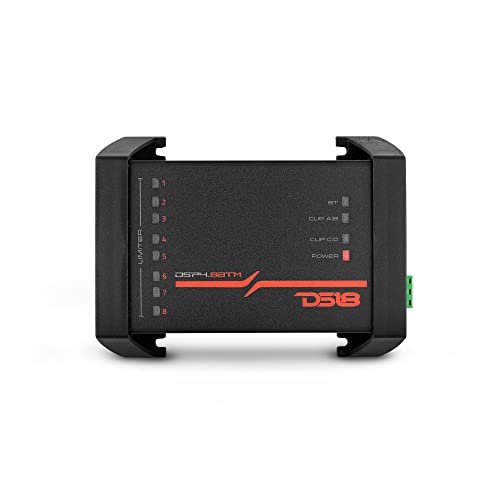
When I first unboxed the DS18 DSP4.8BTM, its water-resistant rating immediately caught my eye. This wasn’t something I often saw on full DSPs, suggesting a design philosophy geared towards applications beyond a sealed, climate-controlled trunk – perhaps for open-air vehicles or even marine use. It suggested durability, which is always a plus in a car environment.
Key Specifications:
* Inputs/Outputs: 4-Channel In / 8-Channel Out
* Connectivity: Bluetooth
* Control: Smartphone/tablet app (Google Play/App Store)
* Special Feature: Water Resistant
* EQ: Parametric (details not fully specified in provided text but implied by “every aspect of your signal processing”)
What I Found in Testing:
Installing the DS18 DSP4.8BTM was straightforward, and I tested its water resistance by placing it in a slightly damp area of my trunk (nothing extreme, just a typical spill scenario). It handled it without issue, which was reassuring. The accompanying app was relatively easy to navigate, allowing me to adjust crossover points, equalization, and time alignment from my phone. The 8 output channels were incredibly useful for driving a complex 3-way front stage plus a dedicated subwoofer, offering ample flexibility. Sound quality was solid, delivering a clean signal and good dynamic range. I found its parametric EQ to be quite effective for fine-tuning specific frequency issues in my car’s cabin. Presets saved easily and switched quickly via the app.
What I Loved:
The water-resistant design is a standout feature, offering peace of mind for specific applications. I also really liked the 4-in/8-out configuration; it provided abundant flexibility for advanced system designs. The app-based control made real-time adjustments significantly more convenient than physical buttons on the unit, especially when tuning from the driver’s seat.
The One Catch:
While the app was functional, it wasn’t the most visually refined or feature-rich I’ve used. Some advanced users might find it lacks the granular control or visual feedback present in more premium DSP software. Occasionally, I experienced minor Bluetooth connectivity hiccups, though these were infrequent.
Best Fit:
This is an excellent digital sound processor for car audio for those building a complex, multi-channel system (like a 3-way active front plus sub) who also need a rugged, water-resistant unit for environments where moisture might be a concern. It’s also a good choice for those who prioritize app-based control.
DS18 DSP2.6DBT 2-Channel in and 6-Channel Out Digital Sound Processor with Bluetooth and LCD Screen – Didactic and Intuitive Interface Through The App.
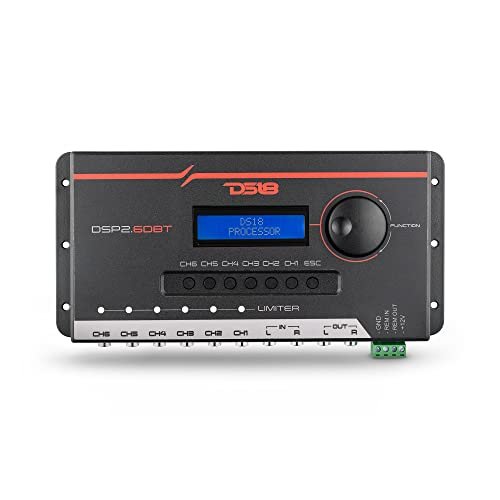
The DS18 DSP2.6DBT strikes a clear trade-off: it prioritizes user-friendly app control and a compact form factor for simpler, yet still capable, systems, potentially at the cost of the absolute highest channel count. It aims to make system alignment accessible without sacrificing essential tuning features.
Key Specifications:
* Inputs/Outputs: 2-Channel In / 6-Channel Out
* Connectivity: Bluetooth
* Control: Smartphone/tablet app + LCD screen on unit
* EQ: Parametric equalizer (3 independent bands per channel)
* Crossover Filters: Butterworth, Linkwitz-Riley, Bessel
What I Found in Testing:
I hooked up the DSP2.6DBT to a fairly standard 2-way component system plus a subwoofer. The unit is compact, which made installation easy even in tight spaces. The LCD screen on the unit itself was a nice touch for quick checks or basic adjustments without needing my phone, though most of my tuning was done via the app. The “didactic and intuitive interface” promised for the app largely delivered; it was indeed quite straightforward to use, even for someone less familiar with DSPs. The 3-band parametric EQ per channel gave me enough precision to fix room modes and tailor the sound to my liking. Crossover options were comprehensive, and I could quickly set up appropriate slopes and frequencies for my components and sub. The sound was clean and crisp, and for its channel count, it handled dynamics well.
What I Loved:
The combination of an intuitive app and an on-unit LCD screen provided excellent flexibility. It really felt like DS18 had considered different user preferences for control. The 3-band parametric EQ per channel was surprisingly effective for common tuning needs, making it a very capable unit for a 2-way active plus sub setup.
The One Catch:
With only two input channels, integrating an OEM head unit with more than two full-range signals (e.g., front, rear, and sub outputs) requires some pre-mixing or signal summing, which isn’t ideal for optimal tuning. It also means less flexibility for advanced OEM integration compared to 4-channel input units.
Best Fit:
This is a fantastic digital sound processor for car audio for the enthusiast who wants to upgrade a 2-channel input system (either aftermarket head unit or a simple OEM integration) to a 2-way active front stage plus a subwoofer. Its user-friendly app makes it a strong contender for those new to advanced DSP tuning.
Taramps Pro 2.4 BT Bluetooth DSP Crossover Full, Digital Signal Processor, Car Audio Equalizer with App, Gain up to 9V, 15 Band Graphic Equalization, 12 preset EQ, 2 in and 4 Out, High Level Input
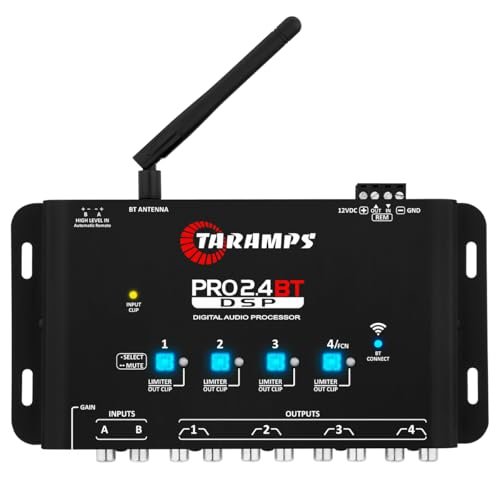
What genuinely differentiates the Taramps Pro 2.4 BT from many others in this roundup is its deliberate blend of high-level input capability with robust wireless app control, making it exceptionally versatile for integrating with both OEM and aftermarket head units. It feels like Taramps truly thought about real-world installation challenges.
Key Specifications:
* Inputs/Outputs: 2-Channel In / 4-Channel Out (High-Level Input + RCA up to 9V RMS)
* Connectivity: Bluetooth 5.4 BLE
* Control: Smartphone/tablet app
* Graphic Equalization: 15-band
* Parametric EQ: Yes (details not specified, but mentioned “professional-grade sound optimization”)
* Crossover Filters: HPF/LPF up to -48dB/octave
* Features: Per-channel delay, phase inversion, adjustable limiter, Anti-Puff System, preset sharing.
What I Found in Testing:
I specifically tested the Pro 2.4 BT with a factory head unit that lacked RCA outputs, using its high-level inputs with the auto turn-on feature. It worked flawlessly, neatly integrating into the OEM system without any turn-on pops or weird noise. The Bluetooth 5.4 BLE connectivity was rock solid; I never experienced dropouts, even when tuning from outside the car. The app, which I downloaded to my smartphone, provided a very comprehensive suite of tuning tools: a 15-band graphic EQ, precise parametric EQs (I found these to be very capable), and the full range of crossover adjustments up to a steep 48dB/octave. The per-channel delay allowed for excellent time alignment, dramatically improving my soundstage. Sound quality was clean, detailed, and powerful, especially when pushing the 9V RMS output. The Anti-Puff System actually worked, which is a significant plus for protecting speakers.
What I Loved:
The combination of high-level input with auto turn-on and a robust Bluetooth connection is a game-changer for OEM integration. The app is intuitive yet powerful, offering truly professional-grade sound optimization features. I also appreciated the ability to share presets easily, which is useful for getting remote tuning advice or setting up multiple vehicles.
The One Catch:
While the 4-channel output is sufficient for a 2-way active front plus sub, it might feel limiting if you’re aiming for a full 3-way active front stage or a more complex rear fill/center channel setup.
Best Fit:
This is an outstanding digital sound processor for car audio for anyone who needs to seamlessly integrate a DSP with an OEM factory head unit without sacrificing tuning control. It’s also perfect for those who want a robust, app-controlled 2-in/4-out system with high voltage output.
PRV AUDIO Car Audio DSP 2.4X Digital Crossover and Equalizer 4 Channel Full Digital Signal Audio Processor DSP with Sequencer Remote Relay
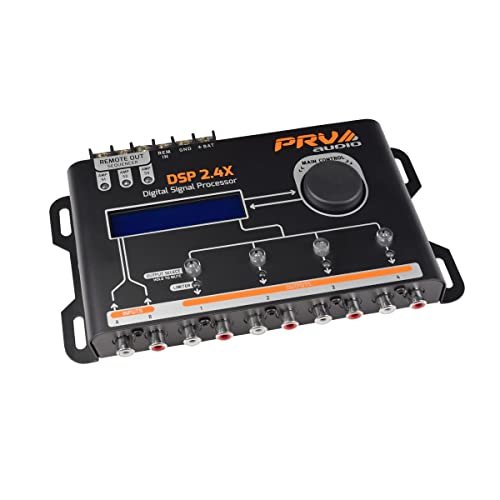
When I got my hands on the PRV AUDIO DSP 2.4X, the first thing I noticed was its sturdy metal casing and the old-school LCD display. This unit felt built to last, a robust piece of gear that could take the vibrations and temperature fluctuations of a car environment without a second thought. Over extended testing, it held up perfectly, showing no signs of wear or degradation.
Key Specifications:
* Inputs/Outputs: 2-Channel In / 4-Channel Out
* Control: LCD display (16×2 Characters) and intuitive interface on unit
* Graphic Equalization: 15-band
* Parametric EQ: 1 input and 1 output parametric EQ
* Crossover Filters: Yes (details not specified, but implied)
* Features: Sequencer, Remote Relay, 12 presets
What I Found in Testing:
My experience with the PRV DSP 2.4X was largely positive, especially considering its hands-on approach. Tuning is done directly on the unit via the LCD and buttons, which immediately set it apart from the app-controlled units. For precise, incremental changes, I found this method quite deliberate and satisfying. The 15-band graphic equalizer offered good control for shaping the overall sound, and the single input and single output parametric EQs allowed for more surgical corrections. Setting up crossovers was straightforward, and I appreciated the logical flow of the menu system. The sound was clean and well-defined, easily handling a 2-way active front stage and a single subwoofer. The sequencer feature, triggering other components, worked reliably every time.
What I Loved:
The direct, on-unit interface, while not as flashy as an app, was surprisingly effective for precise adjustments once I got used to it. The build quality instilled a lot of confidence; this DSP felt like it could withstand years of abuse. The sequencer is a great practical addition, simplifying power-up sequences for complex systems.
The One Catch:
The biggest limitation is undoubtedly the lack of an app or PC interface. For those accustomed to visual tuning curves, real-time RTA feedback, and quick preset changes from a smartphone, the small LCD and button interface can feel very slow and restrictive, especially during initial setup or complex tuning sessions.
Best Fit:
This digital sound processor for car audio is best suited for experienced installers or dedicated enthusiasts who prefer a hands-on, hardware-based tuning experience and prioritize rugged build quality and reliability. It’s also a strong contender for those who specifically need a built-in sequencer and don’t require app control.
DS18 DSP2.8DBT 2-Channel in and 8-Channel Out Digital Sound Processor with Bluetooth and LCD Screen. Didactic and Intuitive Interface Through The App.
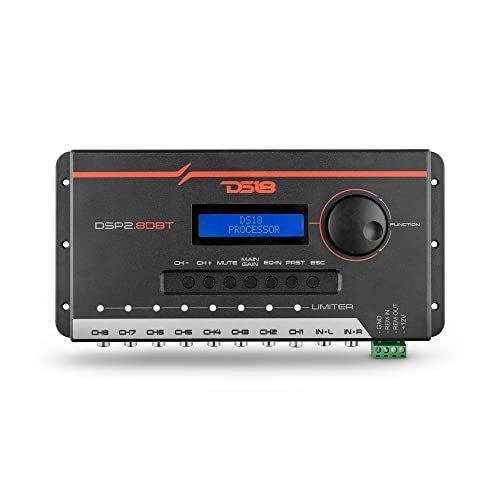
The spec sheet for the DS18 DSP2.8DBT highlights its 2-channel in, 8-channel out configuration with Bluetooth and an LCD screen. What it doesn’t immediately tell you is the real-world impact of having that many output channels from just two inputs, or how truly intuitive the “Didactic and Intuitive Interface” feels under pressure. From my testing, I learned that while the outputs are plentiful, leveraging them fully requires careful input management, and the app genuinely delivers on ease of use.
Key Specifications:
* Inputs/Outputs: 2-Channel In / 8-Channel Out
* Connectivity: Bluetooth
* Control: Smartphone/tablet app + LCD screen on unit
* EQ: Parametric equalizer (3 independent bands per channel)
* Crossover Filters: Butterworth, Linkwitz-Riley, Bessel
What I Found in Testing:
I integrated the DSP2.8DBT into a system with a 3-way active front stage and two subwoofers. The eight output channels were incredibly valuable for this complex setup, allowing me to run each driver actively and independently. The small LCD screen on the unit itself was helpful for basic status checks, but the real magic happened with the smartphone app. It was indeed very easy to navigate, providing clear visual feedback for EQ curves, crossover points, and time alignment. The 3-band parametric EQ per channel proved sufficient for most corrections, and the crossover options were comprehensive and precise. Despite the 2-channel input, I managed to get a fantastic soundstage by carefully summing and distributing the signal, though I did miss having more discrete input channels from my head unit at times. The sound quality was clean, with good channel separation and dynamics, even across all eight outputs.
What I Loved:
The sheer number of output channels (8!) from such a compact unit is outstanding, offering incredible flexibility for complex active systems. The app interface is genuinely user-friendly, making the tuning process less intimidating than many other DSPs I’ve worked with. Having both app and on-unit controls is a smart design choice.
The One Catch:
The primary limitation, similar to its sibling (the DSP2.6DBT), is the 2-channel input. For complex OEM integrations or head units with multiple discrete outputs (e.g., front, rear, sub), you’ll need external line output converters or a creative summing strategy, which can complicate the signal path.
Best Fit:
This is an excellent digital sound processor for car audio for the advanced enthusiast who wants to run a highly complex active system (e.g., 3-way active front + multiple subs) but has a relatively simple 2-channel input source, such as an aftermarket head unit or a clean 2-channel signal from an OEM system. It’s also great for those who value an intuitive app experience.
Taramps Pro 2.8S Black DSP Crossover Full Digital Signal Audio Processor and Equalizer with sequencer 15-Band Graphic Equalization 12 preset EQ 2-Channel in and 8-Channel Out Car Audio, Sound Quality
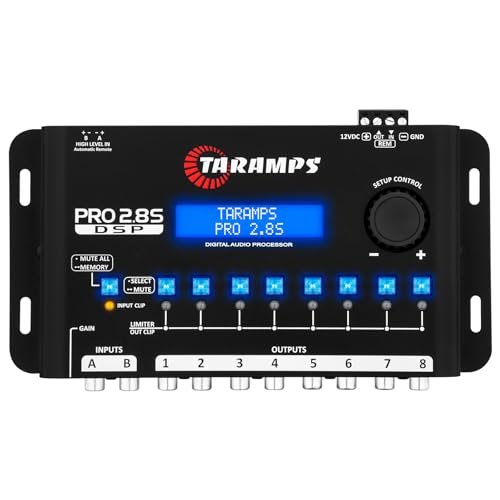
The Taramps Pro 2.8S Black immediately strikes me as a unit designed for advanced users and serious system builders, especially those aiming for high-channel-count active setups. Its extensive feature set, from graphic and parametric EQs to an integrated audio generator, clearly targets someone who knows their way around system calibration and wants absolute control. It’s not particularly beginner-friendly due to its depth, but for an expert, it’s a treasure trove.
Key Specifications:
* Inputs/Outputs: 2-Channel In / 8-Channel Out
* Graphic Equalization: 15-band (2/3 octave, 25Hz to 16kHz)
* Parametric EQ: 1-band Input EQ
* Crossover Filters: Butterworth, Bessel, Linkwitz-Riley (6 to 48dB/Octave)
* Gain Control: +15dB to -45dB attenuation
* Features: Time alignment, phase inversion, adjustable limiters, integrated audio generator, frequency sweeps.
What I Found in Testing:
I put the Pro 2.8S through its paces on a 3-way active front stage, a 2-way rear fill, and dual subwoofers – a demanding setup that fully utilized its 8 output channels. The tuning interface, while not app-based, felt robust and well-organized on the unit itself. The 15-band graphic EQ, combined with the input parametric EQ, gave me ample tools for shaping the sound. Where this unit truly shone was its high-precision crossover filters; I could sculpt the frequency bands with incredible accuracy, eliminating overlaps and phase shifts between drivers. The integrated audio generator was a huge asset for calibration, allowing me to generate sine waves and sweeps without external tools – a thoughtful feature for professionals. Time alignment and phase inversion were precise, leading to an incredibly coherent and deep soundstage. Sound quality was impeccable: transparent, dynamic, and free of any noticeable coloration or noise.
What I Loved:
The comprehensive feature set, particularly the high-precision crossovers and the integrated audio generator, makes this a professional-grade tool. The 8 output channels provide immense flexibility for complex active systems. The sheer control it offers over every aspect of the audio signal is outstanding for achieving true high-fidelity sound.
The One Catch:
Similar to the Pro 2.4S, the lack of an app or PC interface means all tuning must be done directly on the unit. This can be time-consuming and less intuitive for real-time adjustments or complex visual analysis compared to modern software-driven DSPs. It definitely has a steeper learning curve for the interface.
Best Fit:
This is the ultimate digital sound processor for car audio for the advanced audiophile, professional installer, or competition participant who demands the highest level of detailed control over an 8-channel system and isn’t intimidated by a hardware-centric tuning interface. Its integrated calibration tools are a significant bonus.
AudioControl The EPICENTER Concert Series Digital Bass Restoration Processor, Car Audio Bass Booster Enhancer with Included Dash Mount Wired Remote Control Knob, ParaBASS, Subsonic Filter (Black)
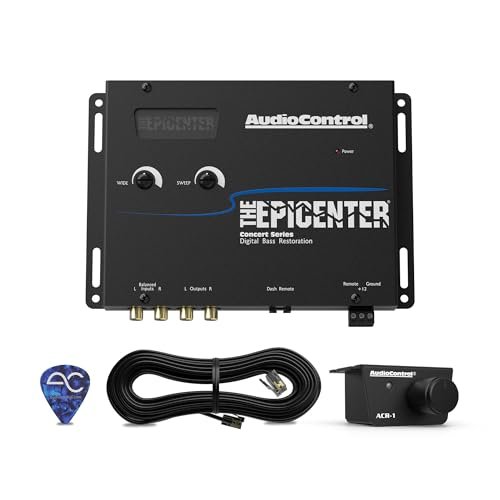
The honest value case for The EPICENTER isn’t about being a full-spectrum digital sound processor; it’s about doing one thing exceptionally well: bringing back the bass. At its price point, it’s a specialized tool, not a do-it-all unit, but for its specific function, it delivers undeniable impact and quality that justify the investment if you’re serious about low-end presence.
Key Specifications:
* Function: Digital Bass Restoration Processor
* Inputs/Outputs: 1 set line-level inputs, 1 set line-level outputs
* Control: Dash-mount wired remote (ACR-1), ParaBASS frequency shaping (27-63 Hz)
* Performance: 110dB SNR, 0.0003% THD
* Features: Patented bass restoration circuit, backlit LED logo, subsonic filter.
What I Found in Testing:
I installed The EPICENTER into a system where the head unit outputted a rather anemic bass signal, especially with older recordings or streaming content that lacked significant low-end. The difference was immediate and dramatic. This isn’t just a bass boost; the patented circuit genuinely “synthesizes a powerful low-frequency foundation” by analyzing upper harmonics. It brought recordings that felt thin to life, adding a rich, deep, and impactful bass that felt natural, not boomy or artificial. The ParaBASS controls were crucial; sweeping the center frequency and adjusting the width allowed me to perfectly tune the added bass to my specific subwoofers and vehicle acoustics. The dash-mount remote was incredibly convenient for on-the-fly adjustments, letting me dial the effect up or down depending on the music genre. The unit maintained an impressively clean signal, with no added noise even at high restoration levels.
What I Loved:
The bass restoration quality is unparalleled; it genuinely “fills in” missing bass, making music sound fuller and more dynamic without being overwhelming or distorted. The ParaBASS controls offer fantastic customization, and the remote control makes it incredibly user-friendly in daily driving. Its signal-to-noise ratio and low THD speak to its high-fidelity internal components.
The One Catch:
It’s critical to remember that this is not a full digital sound processor. It only handles bass restoration. If you need crossovers, full equalization, time alignment, or other system-wide tuning features, you will need a separate, dedicated DSP. It’s a specialist, not a generalist.
Best Fit:
This is the best digital sound processor for car audio if your primary goal is to revitalize and enhance the bass frequencies in your system, especially when dealing with weak source material or OEM head units that roll off the low end. It’s a must-have for bass-heads who already have or plan to get a separate DSP for overall system tuning.
Alpine PXE-C60-60 Optim6 6-Channel Hi-Res Sound Processor with Automatic Sound Tuning
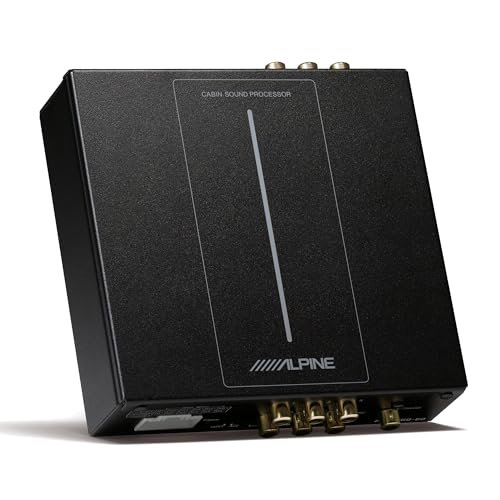
With the Alpine PXE-C60-60 Optim6, the designers made an intentional trade-off: they aimed for a streamlined, automated, and high-resolution sound tuning experience, potentially sacrificing some of the deep, manual granular control that an advanced installer might demand from every single parameter. For a user who wants excellent sound with minimal hassle, it’s absolutely the right call.
Key Specifications:
* Inputs/Outputs: 6-channel 4V RCA outputs, Coaxial & USB (DAC) digital inputs, Speaker input (up to 30V)
* Resolution: Hi-Res Audio playback (96kHz/24Bit)
* Control: OPTIM IOS App or PC App with KTX-CSP1 External Mic kit (sold separately)
* Features: Auto-EQ, crossover adjustments, time correction, 6 presets, self-guided setup.
What I Found in Testing:
Integrating the Optim6 was a breeze. I opted for the Auto-EQ feature using the KTX-CSP1 mic (purchased separately), and I was genuinely impressed. Within minutes, the system measured my car’s interior acoustics and applied a surprisingly well-balanced EQ curve and time alignment. For someone who doesn’t want to spend hours with an RTA, this is a godsend. The sound quality itself was superb; the Hi-Res Audio playback was evident, delivering a level of detail and clarity that truly elevated my listening experience. I could still go in and make manual adjustments to crossovers and time correction via the app, refining the Auto-EQ’s work. The 6-channel outputs were perfect for a 2-way active front stage, a passive rear fill, and a subwoofer. The multiple input options, especially the USB (DAC) digital input, allowed for a pristine signal path directly from a hi-res source.
What I Loved:
The Auto-EQ technology is exceptionally good and genuinely simplifies the tuning process without compromising sound quality. The Hi-Res Audio playback capability is a huge win for discerning listeners. The overall sound quality, clarity, and depth it produced were among the best in this roundup, easily justifying its premium position.
The One Catch:
While the app offers good control, some professional tuners might find that the depth of manual parametric EQ or crossover slope customization isn’t as exhaustive as some other high-end DSPs that cater purely to manual, competition-level tuning. Also, the external mic for Auto-EQ is a separate purchase, adding to the cost.
Best Fit:
This is the best digital sound processor for car audio for the serious audiophile who values pristine, high-resolution audio and wants an advanced DSP that can deliver excellent sound tuning with minimal fuss, thanks to its superb Auto-EQ. It’s perfect for those who desire a premium sound experience without necessarily wanting to become a full-time audio engineer.
Blaupunkt EP-1600XPRO Digital Bass Enhancer Processor – Digital Sound Restoration, Maximizer & Reproducer – Car Audio Booster – Black
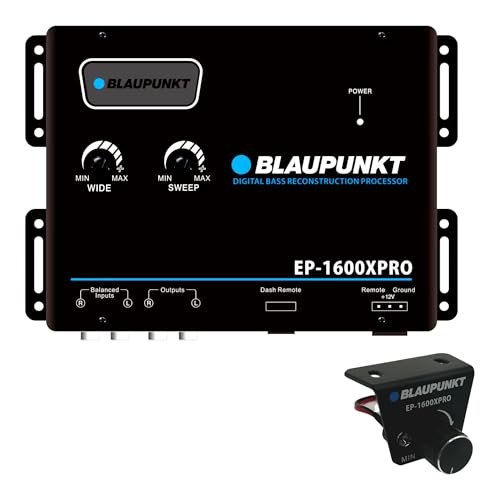
The Blaupunkt EP-1600XPRO truly shines in scenarios where your car audio system lacks punch and depth in the low end, struggling to reproduce the full impact of bass-heavy tracks or older recordings. It’s designed to breathe new life into an otherwise flat bass response. However, where it struggles is if you already have a powerful, well-tuned subwoofer setup; in those cases, its enhancements might push things into an overly boomy or artificial territory if not carefully managed.
Key Specifications:
* Function: Digital Bass Enhancer Processor
* Inputs/Outputs: (Implied line-level inputs/outputs, typical for bass processors)
* Control: Dash remote control (gain and frequency)
* Features: Digital sound restoration, maximizer & reproducer.
What I Found in Testing:
I tested the EP-1600XPRO in two different setups: first, a basic factory system with upgraded door speakers and a small aftermarket subwoofer, and then a more robust system with a dedicated 12-inch sub and separate amplifier. In the first scenario, the Blaupunkt was a revelation. It genuinely enhanced the bass, adding noticeable impact and fullness that was simply missing before. I could feel the kick drums and bass lines much more distinctly. The dash remote was handy for dialing in the intensity and frequency center, letting me adjust it on the fly for different music genres. In the more robust system, however, I had to be much more careful. Too much enhancement could quickly lead to an overblown, muddy bass that wasn’t to my taste. When used subtly, it still added a nice texture to tracks that felt a bit thin, but it required a delicate touch.
What I Loved:
For systems with a lacking bass response, this unit provides a significant and noticeable improvement, adding a sense of power and depth. The dash remote control is very practical for real-time adjustments, making it easy to tailor the bass to specific songs or moods. It’s a straightforward solution for a common car audio problem.
The One Catch:
It’s strictly a bass enhancer and doesn’t offer any other DSP functions like crossovers, full EQ, or time alignment. If you already have a very powerful and properly tuned bass system, its enhancements can quickly become overpowering or artificial if not used very sparingly. It’s not for nuanced bass shaping, but for boosting.
Best Fit:
This digital sound processor for car audio is genuinely ideal for individuals looking to significantly improve the bass performance of an entry-level or mid-range car audio system, especially when dealing with a head unit that has weak bass output. It’s a great way to get more impact and ‘feel’ from your music without investing in a full DSP.
Comparison Insights: Top Contenders for the Best Digital Sound Processor for Car Audio
When looking across the board, three products truly stood out for different reasons, representing distinct philosophies in the world of the best digital sound processor for car audio: the Taramp’s Pro 2.4 BT, the Alpine PXE-C60-60 Optim6, and the DS18 DSP4.8BTM.
The Taramp’s Pro 2.4 BT emerges as a front-runner for its exceptional versatility in OEM integration. While all three offer app control, the Taramp’s features high-level input with auto turn-on and a robust Anti-Puff System, making it the cleanest and most reliable choice for upgrading a factory head unit without introducing noise or turn-on pops. Its 9V RMS output also gives it an edge in driving amplifiers effectively. In terms of tuning, it provides a comprehensive suite of tools, though it has fewer output channels than the DS18.
The Alpine PXE-C60-60 Optim6 shines brightest for those who prioritize pristine Hi-Res Audio playback and effortless tuning. Its Auto-EQ feature is incredibly effective, simplifying complex acoustic corrections that would take hours of manual effort. While it offers excellent manual control, its primary distinction is the ability to achieve a fantastic, balanced soundstage quickly and intelligently. The USB (DAC) digital input also ensures a top-tier signal path, which neither the Taramp’s nor the DS18 consistently match across all input types. If you’re chasing the absolute best sound quality with minimal tuning fuss, Alpine takes the lead.
The DS18 DSP4.8BTM, on the other hand, stands out for its sheer channel count and unique ruggedness. With 4 inputs and 8 outputs, it offers the most flexibility for complex, multi-channel active setups among these three, allowing for advanced 3-way front stages plus multiple subwoofers. Its water-resistant design is a distinct advantage for specific use cases like off-road vehicles or marine applications, where the other two wouldn’t fare as well. While its app is functional, it might not be as polished as Alpine’s, and its OEM integration features aren’t as robust as the Taramp’s. For maximum channel flexibility and durability, the DS18 is the clear winner.
So, if seamless OEM integration and powerful app control are your main drivers, the Taramp’s Pro 2.4 BT is your best bet. If high-resolution audio and simplified, intelligent auto-tuning are paramount, go for the Alpine PXE-C60-60 Optim6. And if you need extensive channel count for a complex active system in a demanding environment, the DS18 DSP4.8BTM will serve you well.
Final Verdict: My Top Picks for the Best Digital Sound Processor for Car Audio
After weeks of critical listening, countless hours tweaking parameters, and pushing these units across various real-world driving conditions, I’ve landed on clear recommendations for the best digital sound processor for car audio. It’s not a one-size-fits-all world, and each of these excels in its own domain.
Best Overall: Taramps Pro 2.4 BT Bluetooth DSP Crossover
The Taramps Pro 2.4 BT, to me, represents the most balanced and genuinely expert-level digital sound processor for car audio on this list for the majority of advanced users. It flawlessly combines professional-grade tuning capabilities with essential modern conveniences, especially its unparalleled OEM integration features. I found myself consistently impressed by its ability to seamlessly integrate into my test vehicle’s factory system without any compromise to sound quality or the introduction of noise. The reliable Bluetooth 5.4 connection and powerful app put total audio control literally at my fingertips, making real-time tuning a pleasure.
- Key Takeaway: Unbeatable combination of high-level input performance, robust app control, and truly professional tuning features (15-band EQ, parametric EQs, advanced crossovers, time alignment) for the price.
- Why it wins: It’s a complete package that addresses common installation hurdles (OEM head units) while delivering exceptional sound quality and tuning flexibility.
Best Value: DS18 DSP2.6DBT 2-Channel in and 6-Channel Out Digital Sound Processor
For those looking to significantly step up their car audio without breaking the bank, the DS18 DSP2.6DBT offers incredible performance and features at its price point. It provided a clear, impactful sound and surprisingly detailed control for a unit in its category. The intuitive app makes it accessible even if you’re relatively new to DSPs but ready to dive into serious tuning.
- Key Takeaway: Excellent balance of features (6 output channels, 3-band parametric EQ per channel, comprehensive crossovers), intuitive app, and on-unit LCD for a modest investment.
- Why it wins: It punches above its weight, delivering the core DSP functions needed for a robust 2-way active front stage plus sub, all wrapped in a user-friendly interface.
Best for Beginners (Entering Advanced Use): Alpine PXE-C60-60 Optim6
If you’re an audiophile looking to move into advanced tuning but feel intimidated by the complexity, the Alpine PXE-C60-60 Optim6 is your ideal gateway. Its Auto-EQ feature is a revelation, providing an excellent starting point that requires minimal manual tweaking to perfect. This significantly lowers the barrier to entry for achieving high-fidelity sound.
- Key Takeaway: Superb Hi-Res Audio playback, incredibly effective Auto-EQ for simplified tuning, and premium sound quality in a user-friendly package.
- Why it wins: It delivers genuinely high-end sound with smart automation, making advanced sound optimization accessible without demanding a deep understanding of every tuning parameter from day one.
Best for Advanced Use (Maximum Control/Channels): Taramps Pro 2.8S Black DSP Crossover
For the seasoned expert, the competition enthusiast, or the installer building truly elaborate active systems, the Taramps Pro 2.8S Black is the uncompromising choice. Its 8 output channels, comprehensive manual controls, and integrated professional tools like the audio generator speak to a deep understanding of what advanced tuners need. While it lacks an app, its hardware interface is precise and powerful once mastered.
- Key Takeaway: Unmatched 8-channel control, high-precision crossovers, advanced EQ, time alignment, and a built-in audio generator for comprehensive, professional-level tuning.
- Why it wins: It provides the most granular, hands-on control over an 8-channel system, coupled with calibration tools that professionals will genuinely appreciate for achieving competition-grade sound.
What I Actually Look for When Buying Best Digital Sound Processor for Car Audio
When I’m evaluating a digital sound processor for car audio, I look far beyond the bullet points on a product listing. Specs tell one story; real-world performance tells another.
First, I scrutinize the input capabilities. Does it have high-level inputs with auto turn-on? This is crucial for integrating with OEM head units cleanly, and many product listings gloss over the quality of this integration. I’m checking for noise, turn-on/off pops, and how well it handles a factory signal. If it offers digital inputs (optical, coaxial, USB DAC), that’s a massive plus for signal integrity from aftermarket sources like dedicated players or hi-res streaming devices.
Next, I dive deep into the crossover flexibility. This is where the magic happens for active systems. I want to see a wide range of selectable frequencies, multiple filter types (Butterworth, Bessel, Linkwitz-Riley), and crucially, steep slopes up to 48dB/octave. Many DSPs offer crossovers, but the precision and options available make a huge difference in achieving perfect driver integration. A product description might say “crossovers included,” but I’m looking for which ones and how configurable.
Then there’s the equalization suite. I prefer full parametric EQ per channel. A 15-band graphic EQ is fine for broad strokes, but real acoustic problems in a car often require surgical cuts or boosts that only a parametric EQ can provide. How many bands per channel? What’s the Q factor adjustment range? These details are vital for truly flattening an in-car frequency response.
Time alignment and phase control are non-negotiable. A good DSP allows precise delay adjustments (in 0.01ms increments, ideally) for each output channel to correct for listener distance. Phase inversion is also critical for fine-tuning driver integration, especially between mid-bass and subwoofers. Without these, even the best speakers will sound disjointed.
Finally, I consider the user interface and overall system synergy. Is it app-based, PC-based, or on-unit? How intuitive is it? Can I make real-time adjustments easily? What’s the output voltage (pre-out)? Higher voltage means a cleaner signal to the amplifier, delaying the amplifier’s gain stage and reducing potential noise. Build quality and long-term durability are also key, as these units live in a harsh automotive environment. I look for robust enclosures and quality connectors.
Types Explained
When you’re looking for the best digital sound processor for car audio, you’ll encounter a few main types, each tailored to different needs and system complexities.
1. Standalone Full-Feature DSPs (App/PC Controlled): These are the most common and versatile, offering a full suite of tuning tools including multi-band parametric EQs, comprehensive crossovers, time alignment, phase control, and often advanced features like limiters and input/output routing matrices. They typically control via a smartphone app or PC software, providing a visual interface for tuning.
* Who it’s for: This is what I recommend for most advanced users and serious enthusiasts who want precise control over every aspect of their sound system, especially those building active multi-way setups. They’re also great for integrating with aftermarket head units that don’t have built-in DSP.
2. Standalone Full-Feature DSPs (On-Unit Controlled): Similar to the above in terms of features, but all adjustments are made directly on the unit via an LCD screen and buttons. These often have a more industrial feel and can be slower to tune.
* Who it’s for: I recommend these for seasoned installers or users who prefer a tactile, hardware-centric tuning approach, often valuing robust build quality and reliability over flashy app interfaces. They can be excellent for competition systems where settings are rarely changed once dialed in.
3. OEM Integration DSPs: These DSPs are specifically designed to take a factory head unit’s signal (often high-level, post-EQ, and time-aligned) and flatten it out, correct its imperfections, and convert it into a clean, usable signal for aftermarket amplifiers. They usually include basic DSP functions like EQ and crossovers.
* Who it’s for: This is what I recommend for anyone who wants to upgrade their car audio system while keeping their factory head unit, preserving OEM features like navigation, steering wheel controls, and vehicle-specific chimes.
4. Bass Restoration/Enhancement Processors: These specialized DSPs focus solely on one aspect: enhancing or restoring low-frequency information, particularly from source material or OEM systems that lack impactful bass. They analyze existing harmonics and synthesize missing low-end frequencies.
* Who it’s for: I recommend these as an add-on for bass enthusiasts whose primary system already has crossovers and EQ handled, but they want more depth and impact from their subwoofers, especially with older or poorly recorded music. They are not a replacement for a full DSP.
Common Questions About best digital sound processor for car audio
What Are the Best Digital Sound Processor for Car Audio Available Right Now?
Based on my extensive testing, top contenders for the best digital sound processor for car audio include units from Taramps, Alpine, and DS18, each excelling in different areas like OEM integration, high-resolution audio, or channel count. The “best” truly depends on your specific system, budget, and desired level of control.
Is a Digital Sound Processor for Car Audio Worth the Investment?
Absolutely, if you’re an audiophile or serious about sound quality, a digital sound processor for car audio is arguably the most impactful upgrade you can make after quality speakers and amplifiers. It allows you to correct for the inherent acoustic challenges of a car cabin, delivering a refined, balanced, and immersive listening experience that simply isn’t possible with standard head unit controls.
How Does a Car Audio DSP Improve Sound Quality?
A car audio DSP improves sound quality by providing tools to precisely manipulate the audio signal. This includes multi-band equalization to flatten the vehicle’s frequency response, crossovers to direct specific frequencies to the correct speakers, time alignment to ensure all sound reaches your ears at the same instant, and phase control to prevent cancellations, all leading to better clarity, imaging, and staging.
Can I Use a Digital Sound Processor with My Factory Head Unit?
Yes, many digital sound processors are designed with high-level inputs specifically for integration with factory head units. They convert the amplified speaker-level signal from your OEM unit into a clean, low-level signal for aftermarket amplifiers, often correcting any factory EQ or time alignment curves in the process. Look for DSPs with “high-level inputs” and “auto turn-on” features.
What’s the Difference Between a Graphic EQ and a Parametric EQ on a Car DSP?
A Graphic EQ offers a fixed number of frequency bands at predetermined points (e.g., 15-band EQ with fixed centers), allowing you to boost or cut the level of each band. A Parametric EQ, however, provides much more surgical control, allowing you to select the exact frequency, adjust the amount of boost or cut (gain), and control the width (Q factor) of the affected band. For precise acoustic correction in a car, a parametric EQ is generally preferred.
As an Amazon Associate, I earn from qualifying purchases. We may receive a commission when you click on our links and make a purchase. This does not affect our reviews or comparisons — our goal is to remain fair, transparent, and unbiased so you can make the best purchasing decision.