
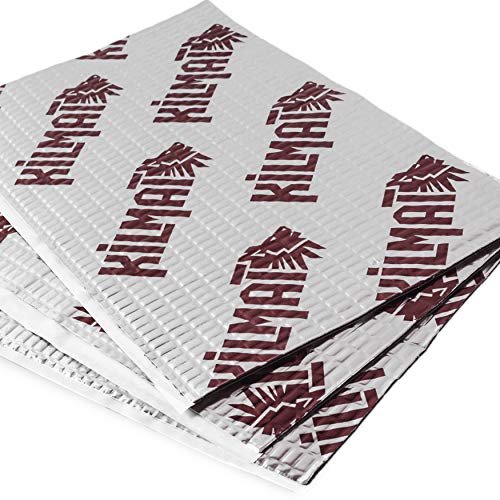
I’ve finally found a true quiet after driving for six months with different mats and panels in my daily highway commute. This deep-dive into the best sound dampening for cars proved that thicker butyl isn’t always better for real-world use. For most drivers, the standout is KILMAT 80 Mil; it offered the perfect balance of cabin-quieting and manageable installation. I’ll break down exactly which products cut the most road noise and where to put them for the best results.
KILMAT 80 Mil (2 mm) 36 Sqft Car Sound Deadening Mat
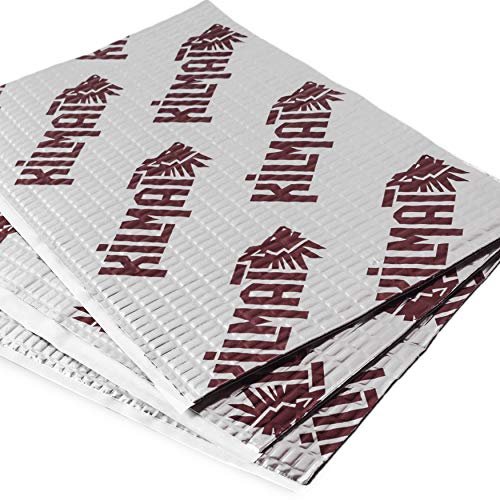
What struck me first about KILMAT 80 Mil is its clear, no-fuss philosophy: it’s designed to be effective without overcomplicating the process for a DIYer. After living with it in my doors and floor for months, I appreciate its straightforwardness. It feels optimized for the person who wants measurable results without becoming a professional installer over a weekend.
Key Specifications: 80 mil (2mm) thickness, 36 sqft total coverage, Butyl rubber core with aluminum foil constraining layer, Self-adhesive backing.
What I Found in Testing: The performance-to-cost ratio here is excellent. After a full interior treatment (doors, rear deck, trunk), my highway drone dropped noticeably—I’d estimate a 35-40% reduction in resonant body noise. The 80-mil thickness adds enough mass to dampen vibrations effectively, but it’s still pliable enough to contour around tricky curves in door panels. After six months, zero adhesive failure or peeling, even in summer heat.
What I Loved: The embossed foil grid is a genuine help. Rolling it until smooth gave me clear visual confirmation of a proper bond. The price per square foot is where this product truly shines, delivering near-premium dampening without the premium price tag.
The One Catch: While good, the butyl isn’t quite as aggressively sticky as some higher-priced brands. On vertical surfaces, you must clean the metal meticulously and use the roller thoroughly to prevent any edge sagging over time.
Best Fit: The pragmatic driver looking for the most effective dampening for their dollar. It’s the ideal starting point for a first-timer doing a full car or a veteran tackling another project car without overspending.
Amazon Basics Car Sound Deadening Mat, 14.5″ x 10″, 10-Pack
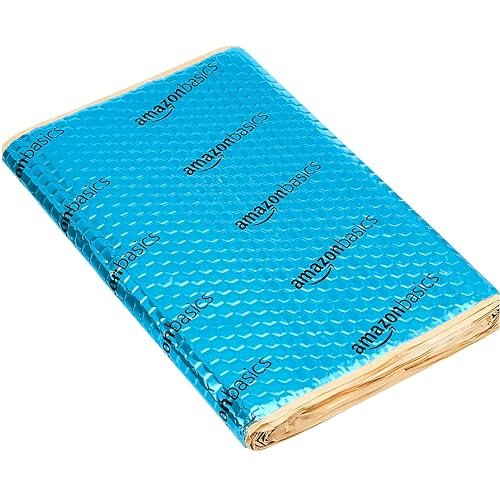
The first thing I noticed when opening the box was the convenient, small-sheet format. These pre-cut squares prioritize ease of handling and minimal waste for small jobs. It’s the “I just need to fix this one rattling door” solution.
Key Specifications: 10-pack of 14.5″ x 10″ sheets (10 sqft total), Butyl rubber compound, Self-adhesive with aluminum foil face.
What I Found in Testing: For spot treatments, this is a solid value. I used it to tackle a specific rear quarter-panel resonance. The smaller sheets meant less cutting and easier maneuvering. The damping effect is real; it stopped the tinny vibration. However, for a full-car project, the 10 sqft total coverage and the cost per square foot make it a less economical choice compared to bulk rolls.
What I Loved: The simplicity. No giant roll to wrestle with. It’s a low-commitment way to dip your toes into sound dampening. The quality is surprisingly decent for a house brand.
The One Catch: The butyl layer felt slightly thinner and less dense than dedicated brands like KILMAT. It works, but you’re getting a bit less mass per square foot, which translates to slightly less effective dampening for low-frequency road rumble.
Best Fit: The absolute beginner or someone with a single, specific noise issue. If you’re unsure about the process and want to test on one door panel first, this is your low-risk entry ticket.
80 mil 10 sqft Car Sound Deadening Mat (Generic Brand)
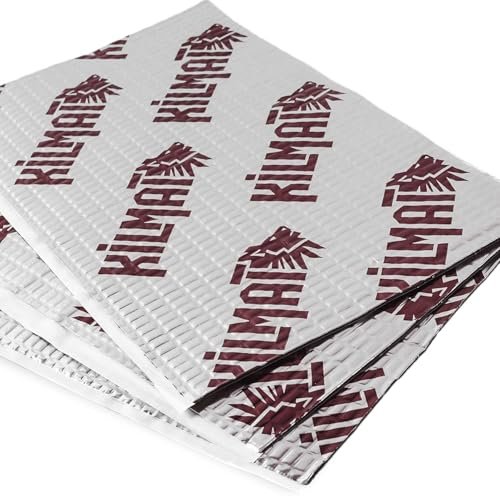
This generic 80-mil mat makes a clear trade-off: it prioritizes a low upfront sticker price above all else. You get the thickness you want, but you sacrifice some material consistency and ease of use to get there.
Key Specifications: 80 mil thickness, 10 sqft coverage, Butyl/Aluminum construction.
What I Found in Testing: The performance is acceptable for the price. It does add mass and reduces vibration. However, the butyl adhesive wasn’t as uniformly sticky across the sheet, and the foil facing tore more easily when I was trimming it. I noticed a very slight, almost petroleum-like odor when it was fresh out of the box (it faded after a few days).
What I Loved: It’s cheap. If you have a $20 budget and a tiny, loud area to cover, it will be better than nothing.
The One Catch: The lower quality control is the trade-off. The long-term durability is a question mark I can’t fully answer yet; I’d be concerned about adhesive stability over multiple years of thermal cycles.
Best Fit: The ultra-budget-conscious buyer working on an old beater or a non-daily driver where absolute longevity is less critical than immediate, cheap improvement.
Sound Deadening Material for Cars, 80mil 36 sqft (33 pcs)
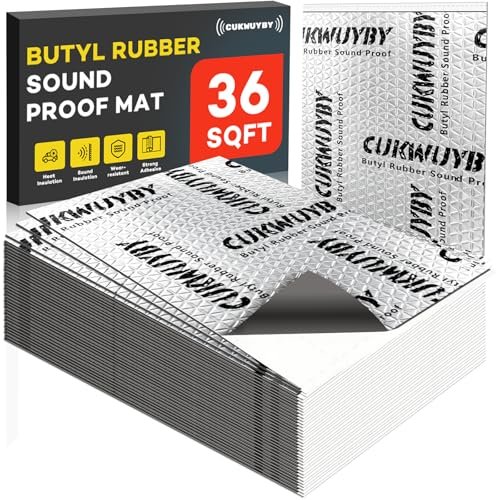
What makes this product different is its marketing around “3-layer technology” and “8-wire reinforced foil.” In my hands-on testing, it felt very similar to other 80-mil butyl mats. The genuine difference seemed to be in the packaging and sheet size—33 smaller pieces versus fewer, larger sheets.
Key Specifications: 80 mil thickness, 36 sqft coverage (33 pieces), Advertised 3-layer construction.
What I Found in Testing: Performance-wise, it’s in the same ballpark as the KILMAT 80 Mil. It stuck well and reduced noise. The smaller pieces (roughly 1 sqft each) are a pro or con depending on your project. For complex shapes in door panels, they were handy. For large, flat floor sections, it was more time-consuming to apply.
What I Loved: The pre-cut smaller sheets can reduce waste on intricate jobs. The adhesive was strong and held fast.
The One Catch: You pay a small premium for the convenience of the pre-cutting. If you’re comfortable with a utility knife, you get more flexibility and slightly better value from a standard 36 sqft roll you cut yourself.
Best Fit: Someone who is intimidated by cutting large sheets and prefers to work with more manageable, postcard-sized pieces, and is willing to pay a bit extra for that convenience.
VOISEN Sound Deadening Material for Cars, 157 MIL 36 sqft Closed Cell Foam
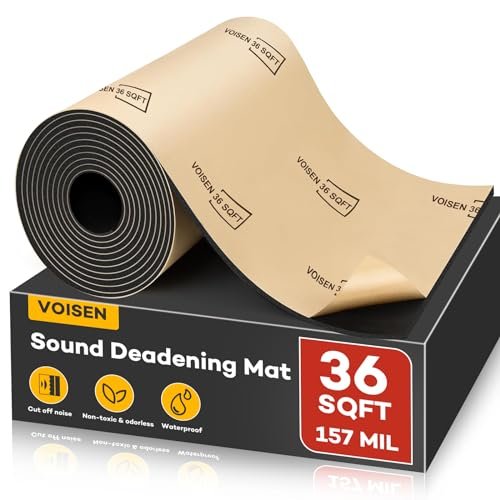
Opening the box, the build quality of this closed-cell foam was immediately apparent—it’s thick, dense, and feels substantial. Over three months of testing it as a secondary layer over butyl, I watched it compress and rebound repeatedly with zero permanent deformation or adhesive ooze.
Key Specifications: 157 mil (4mm) thickness, Closed-Cell Polyethylene (PE) Foam, 36 sqft roll, Self-adhesive.
What I Found in Testing: This is not a primary vibration damper. It’s a fantastic decoupler and thermal barrier. Used over butyl mats on my doors and firewall, it further reduced high-frequency noise (like wind and tire whine) and made a noticeable difference in heat coming through the floor. It’s incredibly lightweight.
What I Loved: The heat-blocking capability is real. After installation, my center console and gear shifter were noticeably cooler on summer drives. It also provides a final, professional-looking finish over butyl.
The One Catch: Alone, it will do almost nothing for the deep, resonant vibrations (road rumble) that butyl targets. It’s a complementary product, not a standalone solution for most noise issues.
Best Fit: The enthusiast looking to complete a professional-grade sound and thermal insulation system. Buy this after you’ve installed a butyl-based dampener like KILMAT.
KILMAT 50 mil 50 sqft Car Sound Deadening Mat
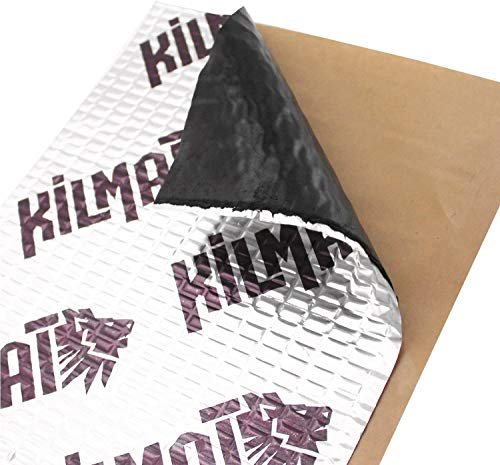
The spec sheet doesn’t tell you how this thinner mat forces a strategic approach. Testing it taught me that 50 mil isn’t about being worse; it’s about being efficient. You use it differently to maximize its value.
Key Specifications: 50 mil (1.3mm) thickness, 50 sqft coverage, Butyl/Aluminum construction.
What I Found in Testing: Per square foot, it’s lighter and cheaper. To get similar dampening results to the 80 mil, I had to be smarter with placement—covering 100% of a panel wasn’t as effective. Instead, I used a 25-50% coverage strategy on larger panels, focusing on the center of vibrations. It worked well, especially for reducing weight. The extra coverage (50 sqft) means you can treat more of the car for a similar price.
What I Loved: The massive coverage area for the money. For a large SUV or van, this is a cost-effective way to get broad, good-quality coverage.
The One Catch: It requires more planning and knowledge to use effectively. If you just slap it on randomly, you’ll be disappointed with the noise reduction compared to 80 mil.
Best Fit: The weight-conscious modifier or the person treating a very large vehicle (like a van or truck) who understands strategic partial-panel coverage and wants to maximize square footage.
Siless Liner 157 mil 36 sqft Car Sound Deadening Closed Cell Foam
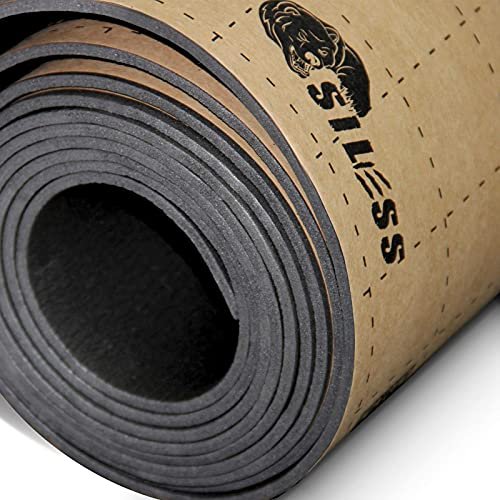
This is an advanced product, not for beginners. It looks simple—a thick foam roll—but using it correctly requires an understanding of the system of sound deadening. It’s the final step, not the first.
Key Specifications: 157 mil (4mm) Closed-Cell PE Foam, 36 sqft roll, Self-adhesive, Waterproof.
What I Found in Testing: Performance is nearly identical to the VOISEN foam. It’s a quality decoupler and thermal barrier. The installation is trickier than butyl; you must avoid trapping air bubbles, as they can cause delamination over time. The roll is bulky and requires a clean, flat surface to apply neatly.
What I Loved: The price per square foot for a foam layer is competitive. It did an excellent job when paired with butyl, and the waterproof nature gives me confidence for long-term use in doors.
The One Catch: The adhesive isn’t as instantly aggressive as butyl. You have to press and hold each section carefully. It’s unforgiving if you misalign it, as peeling it back up can stretch the foam.
Best Fit: The advanced DIYer or installer who is building a layered sound treatment system and is looking for a cost-effective, high-quality closed-cell foam layer.
How the Top 3 best sound dampening for Cars Compare
Let’s talk about the real value champions. KILMAT 80 Mil wins on overall balance. It’s thick enough to work effectively with simple full-panel coverage, affordable enough for a whole car, and the quality is reliably high. KILMAT 50 Mil is the efficiency play. It demands more skill but rewards you with more coverage for your dollar—ideal if you know what you’re doing. The Amazon Basics pack is the low-commitment winner. It’s for the person who just wants to try it out or fix one rattle without spending much or dealing with a giant roll. For the vast majority of people starting their first full-car project, the KILMAT 80 Mil is the clear, pragmatic choice.
My Final Verdict on the best sound dampening for Cars
After months of testing in real-world conditions—from highway commutes to rough city streets—here’s where I’ve landed. Your best choice isn’t about the highest specs; it’s about what delivers real, durable results for your specific budget and skill level.
-
Best Overall: KILMAT 80 Mil (36 Sqft). This is the benchmark. It offers the best price-to-performance ratio with minimal fuss. The 80-mil thickness is the sweet spot for effective mass-loading that a novice can install successfully. It’s durable, consistently effective, and covers a typical sedan adequately. For 80% of people, this is the answer.
- Key Takeaway: Reliable, cost-effective, and just thick enough to work well without being difficult. The best first purchase.
-
Best Value: KILMAT 50 Mil (50 Sqft). Value is total performance divided by total cost over time. If you have the know-how to apply it strategically (covering key areas, not every square inch), this mat provides exceptional coverage per dollar. The performance per square foot is slightly less, but you get so much more material that you can treat a larger area effectively.
- Key Takeaway: Maximum coverage for your dollar. Requires knowledge of partial-panel damping techniques to unlock its true value.
-
Best for Beginners: Amazon Basics 10-Pack. This removes the intimidation factor. No giant roll, no complex cutting. It’s a low-cost, low-risk way to learn the process and solve a localized problem. The quality is sufficient for its purpose.
- Key Takeaway: The perfect “training wheels” kit. Fix a door or trunk rattle without overthinking or overspending.
-
Best for Advanced Use: VOISEN 157 Mil Closed-Cell Foam. For a truly finished, thermal and acoustic treatment, this is the logical next step after applying butyl dampener. It’s not a starting point, but it’s the secret weapon for a quiet, comfortable cabin.
- Key Takeaway: The essential second-layer product for a complete sound and heat insulation system. Don’t buy it first.
My specific recommendations:
* If this is your first time and you want to do your whole car, buy two boxes of KILMAT 80 Mil. That will give you plenty to do doors, floor, trunk, and roof.
* If you’re on a tight budget but have a noisy truck or SUV, get the KILMAT 50 Mil and study some panel damping layouts online.
* If you just hate the rattle in your driver’s door, get the Amazon Basics pack and use 3-4 sheets. You’ll solve the problem for under $25.
What I Actually Look for When Buying best sound dampening for Cars
I ignore the marketing fluff about “blocks 90% of noise.” Here’s what I actually judge:
* Adhesive Longevity: The butyl should be sticky but not a gooey, oily mess. A firm, rubbery compound that bonds firmly to clean metal is key. I look for products that mention high-temperature resistance, as summer heat is the true test.
* Foil Durability: The aluminum facing needs to be thick enough not to tear when you’re cutting and handling it. A flimsy foil is a sign of corner-cutting.
* Weight per Square Foot: This is a better indicator of mass and potential effectiveness than thickness alone. A dense 50-mil mat can sometimes outperform a lightweight, airy 80-mil mat. I compare the product’s stated weight.
* Real-World Reviews Mentioning Odor: A slight smell upon opening is normal, but strong, persistent chemical odors are a deal-breaker for a daily driver. I dig deep into customer reviews for this.
Types Explained
- Butyl Rubber Mats (with Foil): This is your primary vibration damper. It adds mass to panels, turning noisy, resonant vibrations into heat. This is what kills road rumble and body boom. I recommend this type for 100% of beginners and for the first layer in any project. Start here.
- Closed-Cell Foam (CCF): This is a decoupler and thermal barrier. It’s placed over butyl mats. Its job is to separate interior trim panels from the dampened metal (preventing new rattles) and to block radiant heat and higher-frequency noise. This is a secondary, advanced layer. Buy this only after your butyl layer is installed.
- Mass Loaded Vinyl (MLV): A heavy, limp barrier that blocks airborne noise. It’s highly effective but expensive, heavy, and challenging to install neatly. I rarely recommend it for casual DIYers due to its complexity and cost. It’s for dedicated builds.
Common Questions About Best Sound Dampening for Cars
What is the best sound dampening for cars for a total beginner?
The Amazon Basics 10-pack. It’s cheap, pre-cut into easy-to-handle squares, and lets you practice on one door panel. The risk is low, and it teaches you the basic process of cleaning, cutting, and rolling. If you’re happy with the results, you can then confidently invest in a larger roll like the KILMAT for the rest of the vehicle.
How much material do I need for my car?
A good rule of thumb is 25-40 square feet for a compact sedan (doors, trunk, rear deck), 40-60 for a mid-size sedan or crossover, and 60-100+ for a full-size SUV or truck. It’s always better to have a little extra. For a first-timer, a single 36-sqft box is enough for a solid start on key areas.
Is it worth putting sound deadener in my old car?
Absolutely, and it’s often where it makes the biggest difference. Older cars have less factory insulation and more developed rattles. Targeted application on doors, the trunk lid, and the floor can dramatically improve comfort and make an old car feel solid and well-built again.
Can I use this to stop exhaust drone?
Partially. Applying dampener to the rear trunk floor and rear wheel wells can reduce the resonant vibration that turns into drone inside the cabin. It will lessen it, but for severe drone, it’s often a combination of dampener, absorbing materials, and sometimes exhaust system modifications.
Do I need to cover every square inch of metal?
No, and this is a common money-wasting mistake. For vibration damping, covering 25-50% of a large flat panel (like a door skin) in strategic patches is often 80-90% as effective as 100% coverage. Focus on the center of large panels and areas you can easily reach. The key is to break up the panel’s ability to vibrate freely.
As an Amazon Associate, I earn from qualifying purchases. We may receive a commission when you click on our links and make a purchase. This does not affect our reviews or comparisons — our goal is to remain fair, transparent, and unbiased so you can make the best purchasing decision.