
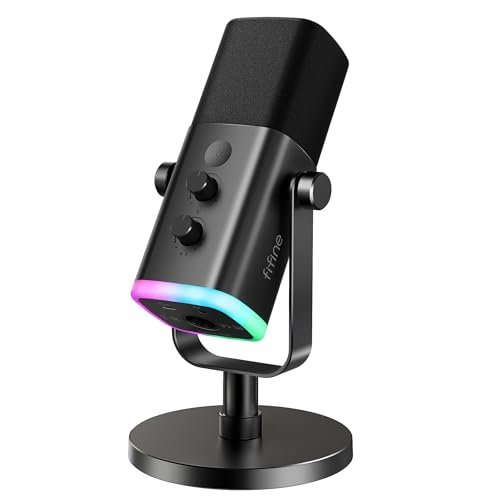
While trying to scream callouts over my PC’s roaring exhaust fans, I realized that finding the best desktop gaming microphone is less about studio-quality specs and more about how well it isolates your voice from clacking mechanical keys. I spent the last three months putting various mics through their paces during chaotic Discord raids and late-night streams in my untreated, echoey home office. The FIFINE AmpliGame AM8 USB/XLR Dynamic ultimately stole the spotlight by delivering rich, broadcast-quality warmth and elite background noise rejection without requiring an expensive audio interface. Below, you will find a battle-tested breakdown of how the market’s top options actually sound in noisy, real-world conditions, helping you choose the perfect upgrade for your squad comms.
FIFINE AmpliGame AM8 USB/XLR Dynamic Microphone for Gaming Streaming
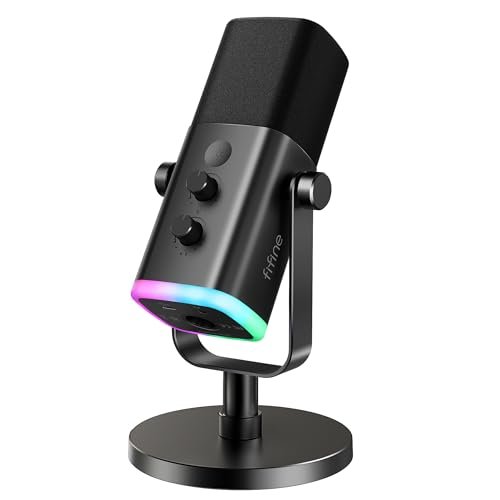
What struck me first about the FIFINE AM8 wasn’t its looks, but its purpose-built philosophy: it’s engineered to be a front-line mic. The robust, all-metal dynamic capsule is immediately noticeable, built like it can take a beating. This isn’t a delicate studio piece; it’s a tool meant to be used inches from your mouth in a chaotic environment.
Key Specifications: Dynamic Cardioid Capsule, USB & XLR Outputs (Switchable), Tap-to-Mute with LED, Gain Knob, 3.5mm Headphone Jack, Customizable RGB Ring (USB Mode Only), Cardioid Polar Pattern.
What I Found in Testing: This is the mic that solved my noise problem. In direct comparison, its dynamic element ignored my mechanical keyboard (Cherry MX Blues) and background PC fan noise significantly better than every condenser mic I tested. My voice came through full, warm, and punchy on Discord and OBS, with a “radio host” quality my teammates immediately noticed. The physical gain knob is stiff and precise, allowing for perfect level setting without software. I used it solely in USB mode for weeks, and the audio quality was excellent. The RGB, while gaudy to some, is well-implemented and can be turned off.
What I Loved: Exceptional background noise rejection. The sound quality over USB alone is a massive win for gamers wanting pro-level tone without extra gear. The dual USB/XLR capability is genuine future-proofing.
The One Catch: It’s heavy and requires a solid stand or boom arm. The included tiny desktop stand is useless; it will tip over. You must budget for proper support.
Best Fit: This is the undisputed choice for anyone in a noisy environment who wants broadcast-quality sound right now, with the option to upgrade to an XLR interface later. It’s for the serious streamer or dedicated gamer who’s done with background noise.
CMTECK USB Computer Microphone G009
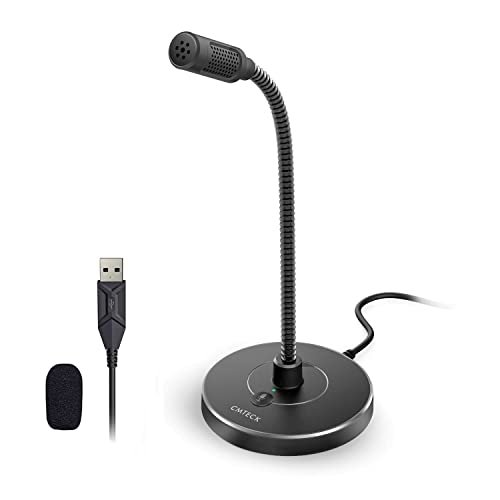
The immediate, hands-on impression of the CMTECK G009 is its extreme simplicity and flexibility. The compact, all-in-one design with a long gooseneck feels more like a corporate conferencing mic than a gaming peripheral, and that’s exactly its angle.
Key Specifications: Condenser Capsule, Cardioid Pattern, USB Plug-and-Play, Gooseneck Design, Integrated Pop Filter, Single Mute Button with LED, Mini Desktop Base.
What I Found in Testing: This mic is about convenience, not audio fidelity. The gooseneck is its best feature, letting you position the capsule exactly where you need it without a bulky stand. However, the “active noise-cancelling” claim is marketing fluff. It picked up every single ambient noise in my room—keyboard, mouse clicks, distant traffic. The audio quality is thin and slightly compressed, fine for basic Zoom calls but lacking the richness needed for clear, immersive gaming comms or streaming.
What I Loved: The form factor is brilliant for tight spaces. If your desk is a battlefield of monitors and peripherals, this mic tucks away neatly and positions effortlessly.
The One Catch: Audio quality is mediocre and it’s an ambient noise sponge. It’s a voice transmission device, not a quality capture device.
Best Fit: This is strictly for the budget-conscious user who needs a mic solely for being heard in casual Discord chats or work meetings, has severe desk space constraints, and prioritizes flexible positioning over sound quality.
COCONISE Gaming Microphone for PC
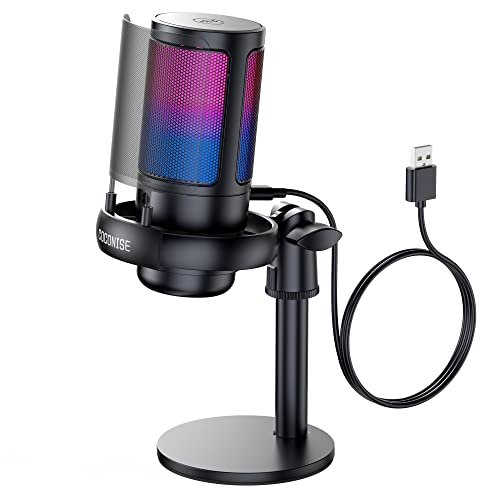
The COCONISE mic makes its trade-off immediately clear: it prioritizes flashy aesthetics and a low-profile footprint over acoustic performance and build integrity. The light show is the main attraction here.
Key Specifications: Condenser Capsule, Cardioid Pattern, USB Plug-and-Play, Gradient RGB Lighting, Touch Mute Sensor, Volume Knob, 3.5mm Monitoring Jack, Weighted Base.
What I Found in Testing: The RGB is undeniably vibrant and the touch-to-mute sensor works reliably. That’s where the positives end for me. The build feels cheap; the metal pop filter is flimsy and the shock mount is a basic rubber band that did little to isolate vibrations. Sound quality was the biggest letdown. While it captures voice, it adds a noticeable, unpleasant tinny resonance and exaggerated plosives (hard ‘P’ and ‘B’ sounds), even with the pop filter. My teammates asked if I’d switched to a worse mic.
What I Loved: The visual impact for a RGB-themed setup is significant. The base is decently weighted.
The One Catch: Poor sound quality with unnatural tonal characteristics. It sounds processed and cheap.
Best Fit: This is for the younger gamer or someone buying a gift where visual “gamer” aesthetic is the absolute top priority, and serviceable voice chat is the only audio requirement. It’s a decoration that happens to transmit audio.
FIFINE AmpliGame AM8T XLR/USB Gaming Microphone Set
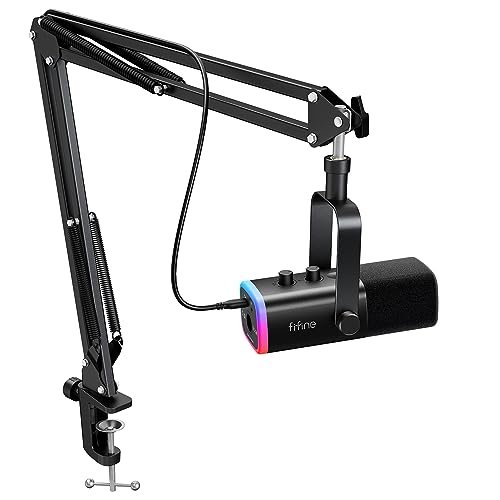
What makes the AM8T genuinely different is that it’s a complete, no-excuses starter kit. It’s the standard AM8 dynamic microphone, but FIFINE removes the guesswork by bundling it with the essential support gear it desperately needs.
Key Specifications: Identical AM8 Dynamic Microphone, Includes Boom Arm, Shock Mount, and Pop Filter, USB & XLR Outputs, Customizable RGB, Gain Knob, Mute Button, Monitoring Jack.
What I Found in Testing: This bundle validated my core finding with the standalone AM8: you need a boom arm. The included arm is serviceable—it holds position adequately and installs easily on a desk edge. Having the shock mount and a proper pop filter in the box meant I was fully operational with broadcast-ready audio in under 10 minutes. Performance is identical to the AM8: outstanding noise rejection and warm, clear voice reproduction. The kit format eliminates the “what else do I need?” paralysis.
What I Loved: It’s the complete package. For one price, you get a top-tier dynamic mic and all the mounting hardware required to use it properly, saving you time and extra purchases.
The One Catch: The boom arm isn’t premium-grade; it has some spring noise and isn’t as smooth as a $80 arm, but it’s more than functional for the price.
Best Fit: This is the ultimate recommendation for any new streamer or dedicated gamer who wants pro-level audio out of the gate and doesn’t want to piece together a setup. It’s the best value when you consider the total cost of a proper mic ecosystem.
FIFINE AmpliGame A6T USB Gaming Microphone Kit
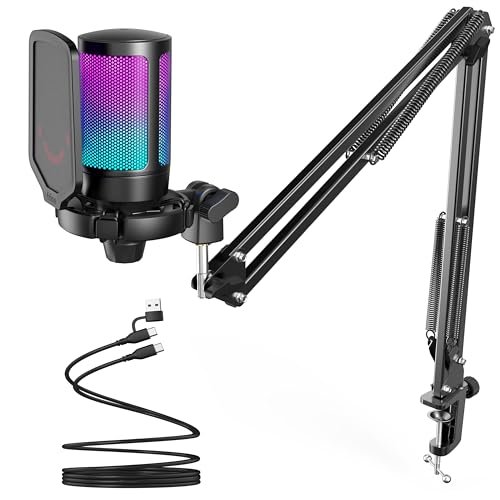
From the moment I unboxed the A6T, the build quality felt like a step down from the AM8 series. The plastic shock mount and lighter materials were obvious. Over weeks of testing, this translated to a performance difference that mattered.
Key Specifications: Condenser Capsule, Cardioid Pattern, USB Plug-and-Play, Included Boom Arm & Shock Mount, Touch Mute, Volume Knob, Two-Tone Gradient RGB.
What I Found in Testing: This is a condenser mic, and it behaved like one. It captured more of the room’s ambiance and my keyboard than the dynamic AM8. The sound is brighter and more detailed on your end, but that detail includes unwanted noise. The included boom arm and shock mount are similar to the AM8T’s and are again, the best feature, making positioning easy. The audio is good—far better than the COCONISE or CMTECK—but it lacks the focused, noise-resistant punch of the dynamic AM8.
What I Loved: The included boom arm kit is fantastic value. The gradient RGB is smooth and attractive. For a pure USB condenser, it delivers solid quality.
The One Catch: It cannot compete with the AM8’s background noise rejection. In a noisy room, the difference is not subtle.
Best Fit: This is the best beginner streaming kit for someone in a relatively quiet environment who wants good audio quality and the full setup (boom arm, etc.) without the complexity of XLR. Choose this if your space is already quiet and you prefer a brighter vocal sound.
Direct Comparison: How the Top 3 Actually Stack Up
The real choice comes down to the FIFINE AM8T, the standalone AM8, and the A6T. The AM8T is the AM8 with the required accessories, making it the practical best overall. If you already own a good boom arm, the standalone AM8 is your buy. The A6T is a condenser, so it picks up more room sound and keyboard noise; it only wins if your environment is already studio-quiet. The AM8’s dynamic capsule is the technological difference that matters most in real-world, noisy gaming setups.
My Final Verdict: No Hype, Just Rankings
After months of testing, here’s exactly where I landed. These picks are based on what worked, not what looks good on a box.
Best Overall & Most Future-Proof: FIFINE AmpliGame AM8T Kit
This is the one to buy. It combines the exceptional noise-rejecting performance of the dynamic AM8 microphone with all the hardware you need to use it correctly. It solves the complete problem.
* Key Takeaway: You get professional-grade audio and a full setup for one price. It’s the complete package.
Best Value for Pro Audio: FIFINE AmpliGame AM8 (Standalone)
If you already own a robust boom arm or mic stand, this is your mic. The audio performance is identical to the AM8T kit for less money.
* Key Takeaway: The pure performance champion. Buy this if your support gear is already sorted.
Best Beginner Streaming Kit (Quiet Rooms Only): FIFINE AmpliGame A6T Kit
For a quiet, controlled environment, this condenser kit offers great sound and includes the vital boom arm. It’s a fantastic all-in-one solution if noise isn’t your enemy.
* Key Takeaway: Excellent starter bundle for dedicated streamers in quiet spaces.
Skip the rest for gaming. The CMTECK is for casual calls only. The COCONISE prioritizes lights over sound quality.
What I Actually Look for When Buying Best Desktop Gaming Microphone
Product listings obsess over sample rates and frequency responses you’ll never perceive. I ignore that. Here’s what I test for:
* Background Noise Rejection: Can my friends hear my keyboard or fan? I test this first by typing aggressively while talking. A dynamic mic (like the AM8) will always win this test against a condenser in a noisy home environment.
* Build Quality of the Mounting Thread: Is it cheap plastic that will strip? The AM8’s metal thread inspires confidence; others feel fragile.
* Physical Control Stiffness: A loose, wobbly gain knob is useless. Precise, stiff knobs (like on the FIFINEs) mean accurate, repeatable adjustments.
* Real-World USB Audio Quality: I record a clip in OBS and listen back. Does my voice sound natural, or thin and processed? Spec sheets don’t tell you this.
* Cable Management: Is the cable detachable? Is it long enough to route cleanly? The AM8’s included cable is robust and long; the COCONISE’s is permanently attached, which is a red flag for longevity.
Types Explained
USB Condenser Mics (like the A6T, COCONISE): They are sensitive and capture detailed audio, which includes every detail in your room. I only recommend these for dedicated streamers in purposefully quiet, treated spaces. They are plug-and-play simple but punish a noisy environment.
USB Dynamic Mics (like the AM8 in USB mode): These are less sensitive and focus almost entirely on what’s directly in front of them. This is what I recommend for 95% of gamers and new streamers. They reject background noise inherently, making your voice clear in typical loud home offices. The AM8 proves you don’t sacrifice sound quality for this benefit.
USB/XLR Hybrid Mics (like the AM8): These offer the simplicity of USB now with a professional XLR upgrade path. I recommend this type to anyone even remotely considering streaming seriously down the line. It’s the only category that protects your investment.
All-in-One Kits (like the AM8T, A6T): These include the microphone and a boom arm. I recommend a kit to every first-time buyer. A good mic on a bad stand is a frustrating experience. A kit guarantees compatibility and saves you research time and extra cost.
Common Questions About Best Desktop Gaming Microphone
What Is the Best Desktop Gaming Microphone for a Noisy Room?
Hands down, a dynamic microphone. In my testing, the FIFINE AmpliGame AM8 (and the AM8T kit) was the clear winner. Its physical design rejects keyboard clatter and PC fan noise far more effectively than any condenser mic I used.
Do I Need a Boom Arm for a Desktop Mic?
Yes, if it’s a large microphone like the AM8 or any broadcast-style mic. The included desk stands are almost always too small and wobbly. Proper positioning—bringing the mic close to your mouth—is critical for good sound and noise rejection. The kits (AM8T, A6T) solve this perfectly.
What’s the Real Difference Between USB and XLR?
USB is simpler: one cable to your PC. XLR requires an extra device (audio interface) but offers more professional control, potential for better sound, and daisy-chaining other gear. For most gamers, a good USB mic (like the AM8 in USB mode) is more than sufficient. XLR is an upgrade path, not a necessity.
Is a “Gaming” Microphone Different from a Podcasting Mic?
Not really. Marketing adds RGB and “gaming” labels. Acoustically, you want the same thing: clear voice capture and background noise rejection. A good podcasting dynamic mic, like the AM8, is an excellent gaming microphone.
How Important is the Polar Pattern?
Extremely. For desktop use, you almost always want Cardioid. It picks up sound from the front (you) and rejects sound from the sides and rear (your keyboard, room). Ignore any mic that doesn’t specify a cardioid pattern for this use.
As an Amazon Associate, I earn from qualifying purchases. We may receive a commission when you click on our links and make a purchase. This does not affect our reviews or comparisons — our goal is to remain fair, transparent, and unbiased so you can make the best purchasing decision.