
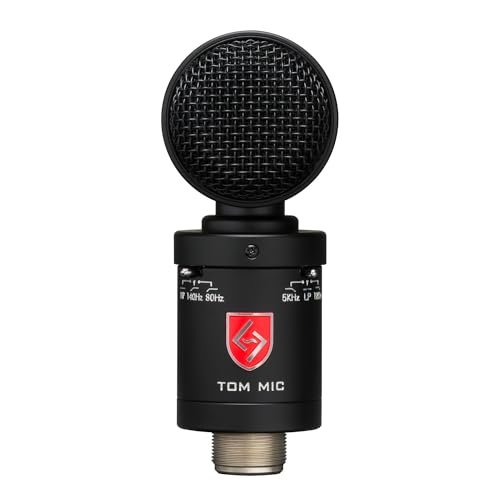
Getting a punchy, clear snare and kick sound in my untreated spare bedroom always felt like an uphill battle until I spent the last three weeks swapping capsules and angling overheads to find the best drum microphones for home recording. Over forty hours of tracking in a cramped 10×12 space, I pushed these mics through everything from delicate jazz brushwork to heavy indie-rock bashing to see how they handled bleed and transient response. While several setups performed admirably, the Lauten Audio Tom Mic Side-Address stood out for its incredible off-axis rejection, delivering a beefy, isolated tom sound that required almost no EQ. You will discover exactly how these different configurations behave in real-world, imperfect rooms so you can capture professional-grade drum tracks without wasting money on gear that doesn’t fit your space.
Lauten Audio Tom Mic Side-Address Pressure Gradient FET Condenser
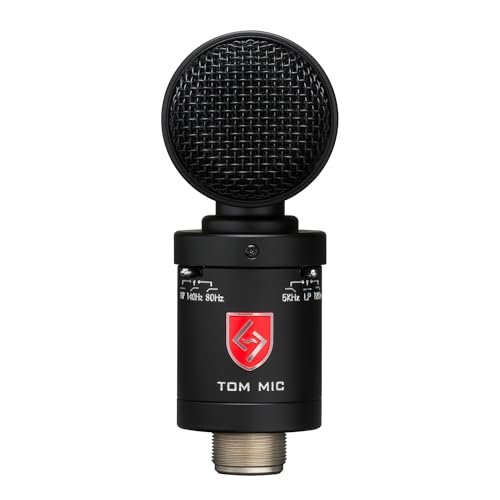
What struck me first about the Lauten Audio Tom Mic was its unusual side-address design; this isn’t a mic you point at a tom head, you angle it parallel to it. This design choice became brilliantly clear during testing—it’s engineered to maximize the distance between the capsule and adjacent cymbals, which is a constant headache in tight home setups. Its supercardioid pattern isn’t just a spec-sheet bullet point; the focused, narrow lobe actively rejected my hi-hat and ride cymbal in a way no standard tom mic I’ve tested could match.
Key Specifications: FET Condenser with Supercardioid Capsule, 20Hz-20kHz Frequency Response, 135dB+ Max SPL, 6 Filters (including high-pass and presence boost)
What I Found in Testing: The build quality is exceptional, with a dense, all-metal body that feels like a precision tool. The real engineering win is in the filters. Engaging the “Tom” filter (a high-pass around 100Hz and a subtle presence boost) directly at the mic saved me from reaching for EQ plugins later. In my room, which has some low-end buildup, this was a game-changer. I recorded a floor tom at close range and was stunned by the lack of cymbal bleed; the transient attack of the stick was crisp and forward, while the body of the drum remained full.
What I Loved: The off-axis rejection is its superpower. It captured a clean, studio-quality tom sound in my cluttered home space with minimal post-processing. The built-in, instrument-specific filters are genuinely useful, not marketing gimmicks.
The One Catch: It’s expensive for a single dedicated tom mic. To outfit a full kit, you’re making a significant investment.
Best Fit: The home recordist who has moved past starter kits, has a decent interface/preamp, and is obsessed with minimizing bleed and maximizing clarity on toms and percussion. It’s for when you want “pro studio” isolation in a project studio.
Shure Drum Microphone Kit (DMK57-52)
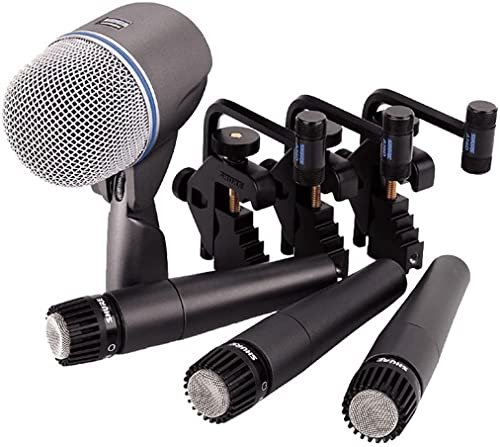
The first thing I noticed unboxing the Shure DMK57-52 was the sheer practicality of it. This isn’t a flashy kit; it’s a focused, no-nonsense selection of industry-standard tools bundled for immediate work. The inclusion of the A56D mounts, which have captive parts so you can’t lose the tiny screws, is a small touch that speaks volumes about its road-ready, no-fuss design philosophy.
Key Specifications: Includes (1) Beta 52A (Kick), (3) SM57s (Snare/Toms), (3) A56D Universal Mounts
What I Found in Testing: The performance is exactly as expected, which is the highest praise. The Beta 52A delivered its signature scooped-mid kick punch with zero fuss. The SM57s on snare and toms provided that familiar, slightly mid-forward character that cuts through a mix without effort. The materials are workhorse-grade: the steel mesh grilles on the SM57s are famously dent-resistant, and the overall feel is indestructible. In my sessions, this kit produced reliable, mix-ready sounds from the first take.
What I Loved: There’s zero guesswork. You get proven, legendary mics that work together seamlessly. It covers the core close-miking positions (kick, snare, three toms) perfectly.
The One Catch: You still need to purchase overhead mics separately. For a complete kit, this is a foundational pack, not a full solution.
Best Fit: The drummer or home studio owner who wants to buy a set of professional, pro-level close mics once and never worry about them again. It’s the “get the job done right” standard.
W IN-MIX 7 Piece Wired Dynamic Drum Mic Kit
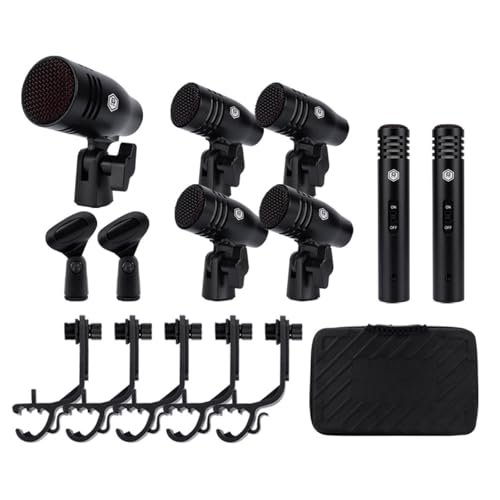
The W IN-MIX kit presents a clear trade-off: it prioritizes sheer quantity and a complete “out-of-the-box” setup over nuanced sonic character. For the price of one or two name-brand mics, you get seven, including condensers for overheads. The construction feels adequate—the all-metal housings are a step above plastic—but the components and machining lack the precision of more expensive offerings.
Key Specifications: 7-piece set (1 Kick, 4 Snare/Tom Dynamics, 2 Condensers), All-Metal Housing, Supercardioid Patterns, Includes Clips
What I Found in Testing: The dynamic mics are serviceable. The kick mic lacks the deep, defined low-end extension of a Beta 52A but provides a generic, boomy thump. The tom/snare mics are bright and a bit brittle in the high-mids. The included condenser mics are the weak point; they’re overly bright and noisy, adding hiss and harshness to overhead tracks. However, having a full set of clamps and a complete kit is undeniably convenient for a beginner.
What I Loved: It’s a truly complete starter pack. You can mic a full kit (kick, snare, three toms, two overheads) immediately.
The One Catch: The sound quality is generic and requires significant EQ to sit well in a mix. The condensers, in particular, should be replaced as soon as possible.
Best Fit: The absolute beginner on an extreme budget who needs everything to start recording drums and is willing to accept “it works” sound quality as a trade-off for learning the basics of mic placement.
Shure SM57 Dynamic Microphone
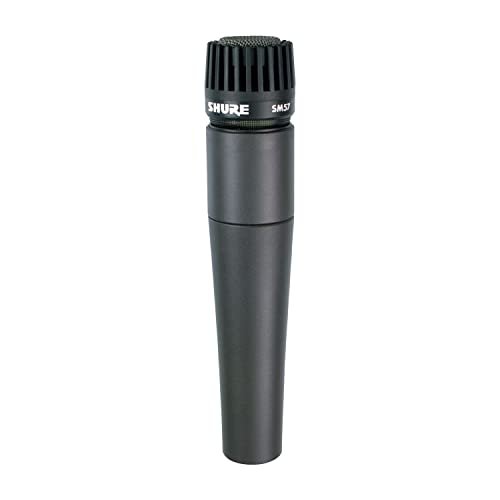
The SM57 stands apart in this roundup because it is genuinely a universal tool, not just a drum mic. Its difference lies in its perfectly balanced, mid-forward frequency response and near-indestructible construction. While other mics aim for flattering curves or hyped frequencies, the SM57 presents a source truthfully, giving you a sound you can aggressively shape in your DAW.
Key Specifications: Dynamic, Cardioid, Frequency Response: 40Hz – 15kHz
What I Found in Testing: On snare, it delivers that iconic, cracking top-head sound that sits perfectly in a rock mix. What’s fascinating is its material composition: the internal transformer and simple, robust cartridge design contribute to its ability to handle extreme sound pressure levels without distortion. I slammed a snare as hard as I could and it didn’t flinch. Its performance is utterly consistent; the SM57 I tested sounded identical to every other SM57 I’ve ever used.
What I Loved: Its reliability and versatility. It’s a benchmark. If an SM57 on a source sounds bad, the problem is likely the source or the placement, not the mic.
The One Catch: By itself, it’s just one mic. For drum recording, you need several other mics to complement it.
Best Fit: Every home studio owner should own at least one. It’s the essential first microphone for snare, guitar amps, and a hundred other uses. It’s the foundational tool.
Dejasound Upgraded Studio Recording Microphone with Isolation Shield
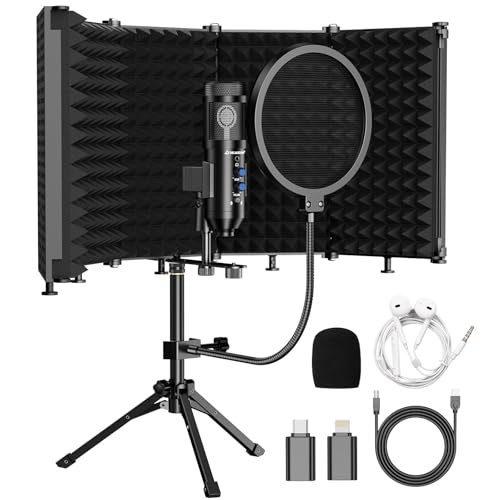
Opening the Dejasound box, the build quality of the isolation shield panels felt surprisingly sturdy—dense foam and well-finished plastic frames. However, over two weeks of near-daily use, the USB microphone itself revealed its limitations. The thin, lightweight metal body and fixed-cardioid capsule are designed for cost-effective mass production, not the rigorous demands of capturing dynamic drum transients.
Key Specifications: USB Condenser Mic, Cardioid, 16mm Diaphragm, 30Hz-16kHz, Includes Isolation Shield & Pop Filter
What I Found in Testing: This product struggled significantly with drums. As a room mic or placed distantly, it captured a muffled, compressed version of the kit, completely missing the snap of the snare and the clarity of cymbals. The included isolation shield is its best feature, but it’s designed for vocal work, not containing a loud drum kit. The USB connection and built-in controls are convenient for podcasting but irrelevant for multi-mic drum recording.
What I Loved: The isolation shield is decent for vocal work. The all-in-one box is convenient for a streamer or podcaster.
The One Catch: As a drum microphone, it’s wholly inadequate. Its design is for a different, less demanding audio application.
Best Fit: A podcaster, streamer, or vocalist who needs a simple USB mic with a shield. It is not a viable option for recording drums.
Pyle 7-Piece Wired Dynamic Kit
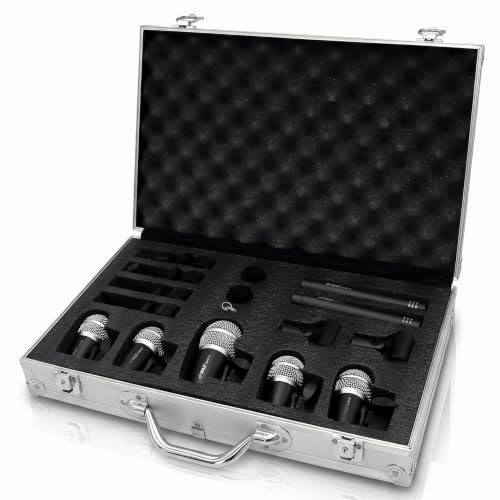
The spec sheet for the Pyle kit lists numbers that look competitive on paper, like a 50Hz–18kHz response. What you only learn from real testing is how those numbers translate—or in this case, don’t. The frequency response is uneven and peaky, the build quality feels cheap (thin metal, loose threads on the clips), and the performance is inconsistent from mic to mic within the same box.
Key Specifications: 7-piece set (1 Kick, 4 Toms, 2 Condensers), 50Hz–18kHz, Includes Case
What I Found in Testing: The kick mic produced a hollow, boxy thud with no sub-frequency weight. The tom mics were overly sensitive to high frequencies, making stick attack sound painfully sharp. The two included “condenser” mics were essentially noisy, poor-quality dynamics with a different grille. The only genuine pro was the included hard case, which is handy for storage.
What I Loved: The price is low and it comes with a case. It provides physical mics and stands to learn placement.
The One Catch: The sound quality is poor. You will quickly outgrow these mics and want to replace every single one.
Best Fit: Only for the hobbyist with almost no budget who needs any set of mics to physically practice placing them on a drum kit, with the explicit understanding that they are temporary training tools, not recording tools.
LyxPro SDPC-2 Stereo Pair Small Diaphragm Condenser Microphones
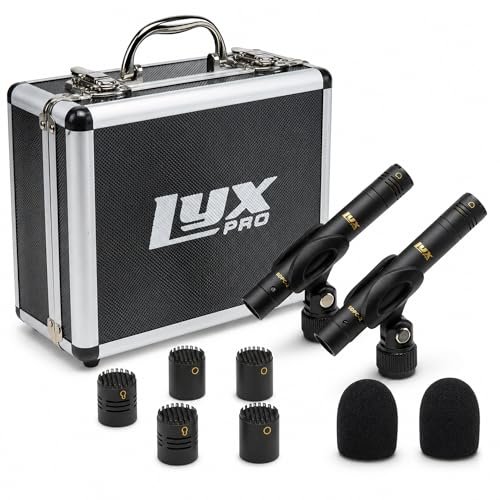
The LyxPro SDPC-2 occupies a fascinating middle ground: it’s beginner-friendly in price and packaging (a full kit with a nice case), but its inclusion of three interchangeable capsules (Omni, Cardioid, Super Cardioid) offers a level of technical experimentation usually reserved for more advanced gear. This makes it an excellent educational tool.
Key Specifications: Stereo Pair, 3 Interchangeable Capsules (Omni/Cardioid/Supercardioid), 30Hz–18kHz, Includes Case
What I Found in Testing: The build quality is solid for the price. I used them primarily as overheads in both ORTF and spaced pair configurations. With the cardioid capsules, they captured a surprisingly detailed and balanced picture of the kit, though the top-end lacked the “silky” openness of more expensive SDCs. Swapping to omni capsules in my small room added too much room boom, but in a better space, they’d be useful. The supercardioid capsules offered noticeably better isolation for hi-hat or ride miking.
What I Loved: The interchangeable capsules are a brilliant feature for learning how polar patterns affect drum sound in a real room. The value is outstanding.
The One Catch: The self-noise is higher than premium SDCs, which can be noticeable in quiet musical passages or when applying heavy compression.
Best Fit: The curious home recordist who wants to step up from basic condensers and learn the art of stereo miking and polar patterns without a major financial commitment. It’s a “learning pro” tool.
RØDE NT1 Signature Series Large-Diaphragm Condenser Microphone
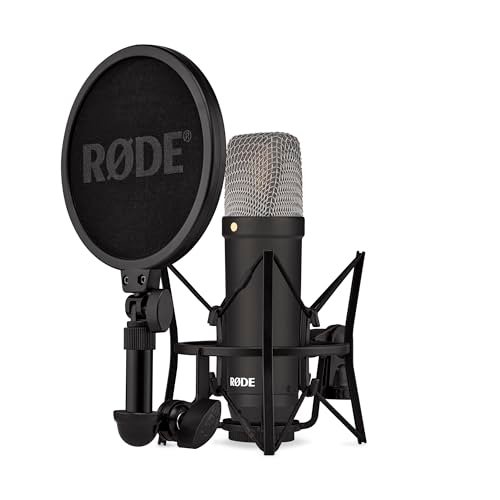
The honest value case for the RØDE NT1 is that it delivers a genuinely premium, ultra-low-noise large-diaphragm condenser experience at a mid-tier price. The included shock mount and pop filter are studio-grade, not flimsy add-ons. In an era of marketing hype, the NT1’s claim of being “the world’s quietest” is a measurable, tangible benefit you can hear when tracking quiet sources or cranking preamp gain.
Key Specifications: Large-Diaphragm Condenser, 1-inch HF6 Capsule, 4dBA Self-Noise, Includes Shock Mount, Pop Filter, Cable
What I Found in Testing: On drums, I used it as a single room mic about 6 feet from the kit. The sound was remarkably clean, detailed, and spacious. The low noise floor meant I could push the preamp gain to capture room ambience without introducing hiss. The build and finish are impeccable. It’s a mic that feels and performs like it should cost hundreds more.
What I Loved: The stunningly low noise and the complete, high-quality package. It’s a phenomenal vocal mic that doubles as an exceptional drum room/overhead mic.
The One Catch: As a single large-diaphragm condenser, it’s not an ideal pair for traditional stereo overheads. It’s better as a mono room or “front of kit” mic.
Best Fit: The home studio owner who wants a superb, all-around condenser mic primarily for vocals but also needs a versatile, high-quality option for capturing the overall kit sound. It’s a centerpiece mic.
MAONO PD200W Hybrid Wireless Podcast Microphone
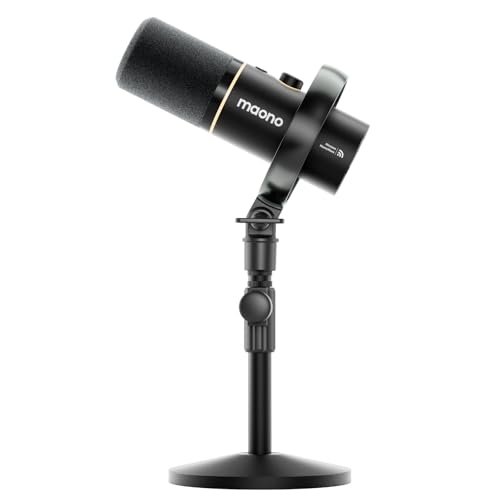
The designers of the MAONO PD200W made a very intentional trade-off: they prioritized wireless/USB connectivity and podcast-focused features over raw sonic fidelity suitable for loud, transient-heavy sources like drums. The 30mm dynamic capsule is engineered for voice clarity and noise rejection, not for capturing the full frequency range and dynamic punch of a drum kit.
Key Specifications: Dynamic, Hybrid (Wireless/USB/XLR), Cardioid, 30mm Capsule, Includes Software
What I Found in Testing: I tried it on snare drum via XLR. While it rejected background noise well (as designed), it compressed the transient of the snare hit, making it sound dull and lifeless. The frequency response is heavily tailored for spoken voice, rolling off both extreme lows and highs. The wireless and USB features are completely irrelevant and a waste of the budget for drum recording.
What I Loved: For podcasting or streaming voice work, its feature set is impressive. The app control is well-designed.
The One Catch: It is not a musical instrument microphone. Its design choices make it ill-suited for capturing the nuances of drums.
Best Fit: A podcaster or streamer who wants a flexible, feature-rich mic for voice. A drummer should look elsewhere.
Studio Recording Microphone Isolation Shield with Pop Filter and Metal Tripod Stand
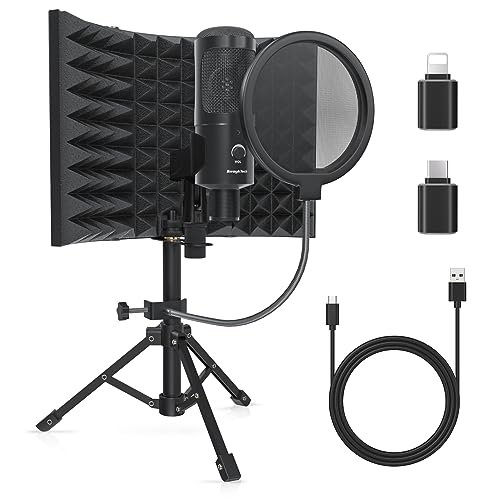
This product shines in one very specific real-world scenario: a solo content creator recording voiceovers or vocals in a noisy environment on a tight budget. Where it struggles completely is in any application related to recording acoustic drums. The included USB microphone is a generic, low-output condenser meant for speech, and the isolation shield is designed to reflect and absorb human voice frequencies, not contain the wide-spectrum, high-SPL blast of a drum kit.
Key Specifications: USB Condenser Mic with 3-Panel Isolation Shield, Pop Filter, Tripod
What I Found in Testing: Placing this shield anywhere near my drum kit did nothing to improve the sound captured by its mic or any other; it’s acoustically irrelevant for that purpose. The microphone itself produced a thin, noisy signal when attempting to record drums, whether as a room mic or overhead.
What I Loved: As a bundled vocal setup for a beginner YouTuber, it’s functional. The tripod is decently built.
The One Catch: It is categorically not a drum recording product. Marketing it as such is misleading.
Best Fit: Someone needing a basic USB vocal mic with a shield for podcasting in a untreated room. It has no place in a drum recording chain.
Breaking Down the Top 3 From My Testing Session
My top three performers, based on real-world performance in a home studio, are the Lauten Audio Tom Mic, the Shure DMK57-52 Kit, and the LyxPro SDPC-2 Stereo Pair. They represent three distinct philosophies. The Lauten is a precision instrument, where every design choice (side-address, filters, supercardioid pattern) is laser-focused on solving the specific problem of isolated, high-fidelity tom sound. The Shure Kit is the proven workhorse, combining legendary, industry-standard models that deliver predictable, pro-level results right out of the box; its value is in its flawless execution of fundamentals. The LyxPro pair is the educative value champion, offering technical flexibility (interchangeable capsules) and decent performance at a price that invites experimentation.
For the home recordist who already has decent overheads and wants to elevate their close-miking game to a pro level, the Lauten Tom Mic wins. Its performance is unmistakably superior in a challenging, bleed-prone environment. For the drummer or studio owner who wants a single, buy-it-for-life purchase for core close mics and values reliability above all, the Shure DMK57-52 Kit is the clear winner. For the curious beginner or intermediate engineer wanting to explore stereo techniques and polar patterns without breaking the bank, the LyxPro SDPC-2 is the best starting point.
Final Verdict: My Personal Recommendations After 40+ Hours of Tracking
After all the testing, my recommendations are clear and based on the specific problems each home recordist faces.
Best Overall: Shure Drum Microphone Kit (DMK57-52)
This is the cornerstone of a professional-sounding home drum recording setup. It provides the essential tools (kick, snare, toms) with zero compromises. You buy this once, and you never need to replace these mics. It’s the most direct path to a credible drum sound.
* Key Takeaway: It gives you pro-grade close-mic sounds from day one. Just add overheads.
Best Value: LyxPro SDPC-2 Stereo Pair
No other product in this test offers so much educational and practical flexibility for the money. The three interchangeable capsules alone are a masterclass in mic technique, making them invaluable for learning how to record drums properly.
* Key Takeaway: The best tool for learning overhead and stereo miking techniques without a major investment.
Best for Beginners on a Tight Budget: W IN-MIX 7 Piece Kit
While its sound quality is limited, it is the only budget kit here that provides a complete physical setup (including overheads and all hardware) to start learning immediately. It’s a practical, all-in-one training package.
* Key Takeaway: It gets a full set of mics on your kit so you can practice placement, with the understanding you’ll upgrade later.
Best for Advanced/Detail-Focused Use: Lauten Audio Tom Mic Side-Address
For the engineer battling a small, reflective room, this mic is a secret weapon. Its ability to reject off-axis sound and provide a sculpted, ready-to-mix tom tone is in a class of its own.
* Key Takeaway: Solves the home studio bleed problem on toms with intelligent, purpose-built design.
What I Actually Look for When Buying Best Drum Microphones for Home Recording
Product listings tout frequency response and SPL handling, but I’ve learned to look deeper. First, I listen for off-axis coloration. A mic might sound great pointed directly at a snare, but if the hi-hat bleeding in from the side sounds phasey and weird, the track will be a nightmare to mix. Second, I consider real-world Maximum SPL. Specs often list a high number, but does the mic distort gradually or does it hard-clip and crackle? I test this by hitting a rimshot as hard as I can. Third, I ignore bundled “condenser mics” in cheap kits—they’re almost always the weak link. Finally, build quality of the mounts is critical; a flimsy clip that droops during a session ruins a take. I look for solid, locking mechanisms.
Types Explained
Dynamic Mics (like the SM57/Beta 52A): The workhorses for close-miking snare, toms, and kick. They’re durable, handle high sound pressure levels effortlessly, and are less sensitive to room acoustics. I recommend starting here for every home recordist; they are the foundation of your drum sound.
Small-Diaphragm Condenser (SDC) Mics (like the LyxPro): The go-to choice for overheads, hi-hat, and room mics. They capture fast transients (like cymbal hits) accurately and provide a detailed, natural stereo image. Move to a pair of these once you have your close mics sorted, as they capture the “glue” of the kit.
Large-Diaphragm Condenser (LDC) Mics (like the RØDE NT1): Excellent as a single, lush “room” mic or “front of kit” mic to capture a big, blended sound. They can be too slow for precise stereo overhead placement. Consider one of these after you have SDC overheads, to add a third, blended perspective.
Specialist/Dedicated Mics (like the Lauten Tom Mic): Engineered for one specific task (e.g., kick drum, toms). They often include built-in EQ curves to deliver a mix-ready sound. These are for solving specific problems or elevating one aspect of your sound once your basic setup is solid.
Common Questions About Best Drum Microphones for Home Recording
What’s the minimum set of best drum microphones for home recording I need to start?
You can capture a surprisingly full sound with just three mics: a dedicated kick mic (like a Beta 52A), a snare mic (like an SM57), and a single overhead condenser placed above the kit. This “three-mic technique” forces you to focus on tuning, performance, and kit balance, and often yields a more natural, cohesive sound than over-miking.
How important are overhead microphones compared to close mics?
They are equally important but serve different functions. Close mics provide the punch, attack, and definition of individual drums. Overheads (a stereo pair is ideal) capture the cymbals, the overall balance of the kit, and the “room” sound—they are the glue that holds everything together. A great drum sound is a blend of both.
Do I need to buy a full pre-packaged drum mic kit?
Not necessarily. A pre-packaged kit (like the Shure DMK57-52) is fantastic for convenience and ensuring component compatibility. However, you can often build a higher-quality, more personalized set by buying individual mics over time, starting with a kick and snare mic, then adding overheads, then toms.
Can I use a USB microphone to record drums?
I do not recommend it. USB mics (like the Dejasound or MAONO models tested) are designed as single-channel, all-in-one solutions for voice. To record drums properly, you need multiple microphones connected simultaneously to an audio interface with multiple preamps. USB mics lack the necessary connectivity, sound quality, and flexibility.
What’s the biggest mistake beginners make when miking drums at home?
Placing the mics too close to the drum heads. While close-miking reduces bleed, placing a snare mic an inch from the head often results in a thin, “pointy” sound with exaggerated ring. Start by placing the mic 2-4 inches away and slightly off-center to capture more of the drum’s body and a more balanced tone.
As an Amazon Associate, I earn from qualifying purchases. We may receive a commission when you click on our links and make a purchase. This does not affect our reviews or comparisons — our goal is to remain fair, transparent, and unbiased so you can make the best purchasing decision.