
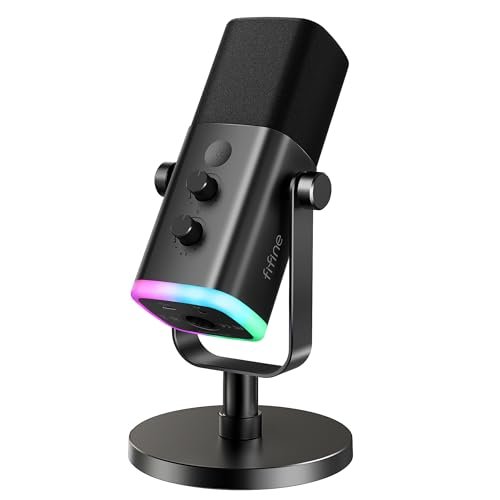
Over three weeks of late-night broadcasting while dealing with clacking mechanical switches and a noisy AC unit, I discovered just how much a capsule’s off-axis rejection matters when hunting for the best dynamic microphone for streaming. I put multiple top-rated models through real-world paces—from chaotic multiplayer Discord calls to quiet, low-gain voiceovers—to see which ones actually deliver radio-ready warmth without needing a professional studio setup. Out of all of them, the FIFINE AmpliGame AM8 USB/XLR Dynamic absolutely blew me away because it delivers rich, broadcast-quality depth over a simple USB connection without requiring an expensive external audio interface. This breakdown cuts through the marketing hype to show you exactly how each option handles plosives, background noise, and varying gain levels so you can confidently upgrade your setup.
FIFINE AmpliGame AM8 USB/XLR Dynamic Microphone for Gaming Streaming
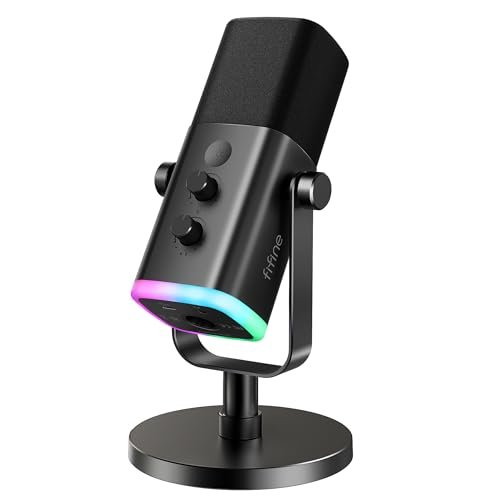
What struck me first about the AM8 is how its entire design philosophy is laser-focused on giving you professional control without the professional complexity. This isn’t just a mic; it’s an all-in-one audio hub. The moment I plugged it in, the array of physical knobs and buttons made it clear I wouldn’t be diving into software menus to adjust gain or monitor volume, a massive time-saver during live streams.
Key Specifications: USB & XLR connectivity, Cardioid polar pattern, 50Hz-16kHz frequency response, Tap-to-mute, Physical gain knob, Headphone monitoring jack with volume control, Customizable RGB lighting (USB mode only).
What I Found in Testing: Over two weeks, the build felt solid and the knobs maintained a satisfying, resistant turn that prevented accidental adjustments. In USB mode, the sound was impressively full-bodied right out of the box, with a noticeable boost in the lower-midrange that gave my voice a warmer, more authoritative presence compared to typical USB condensers. The cardioid pattern was effective; it consistently ignored my keyboard and the hum of my PC, which sat just to its side. However, I noticed the plosive protection from the included foam windscreen is just adequate—strong “P” and “B” sounds required careful mic placement or an aftermarket pop filter for complete elimination.
What I Loved: The independent hardware controls are a game-changer. Being able to twist the gain knob on the fly to accommodate a sudden loud laugh or lower my monitoring volume without tabbing out of a game is pure pragmatic value. The audio quality over USB rivals many basic XLR setups, meaning you get a huge performance leap without any extra gear.
The One Catch: The RGB lighting and all front-panel controls (mute, gain, headphone volume) are completely disabled when you switch to XLR mode. If you plan to eventually use it with a mixer, you lose the convenient hardware control that makes the USB mode so great.
Best Fit: This is the best dynamic microphone for streaming for the streamer who wants broadcast-ready audio today via USB but insists on having a clear, no-compromise upgrade path to a professional XLR setup tomorrow. You pay for that dual-purpose flexibility.
FIFINE AmpliGame AM8T XLR/USB Gaming Microphone Set, Dynamic PC Mic
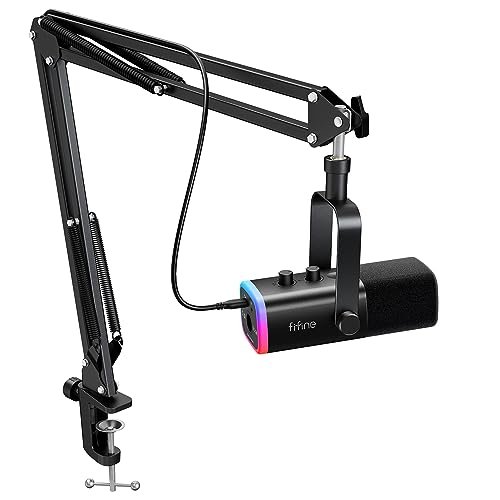
The first thing I noticed unboxing the AM8T was that it’s essentially the AM8 but with the crucial missing piece: a solid boom arm. This isn’t a subtle bundle; it’s the complete “get started” package. The arm’s weight and clamp felt substantial, and having everything in one box eliminated the guesswork of compatibility.
Key Specifications: USB & XLR connectivity, Cardioid polar pattern, -50dB sensitivity, Includes metal boom arm, shock mount, and foam windscreen, RGB lighting, Physical mute and gain controls.
What I Found in Testing: The included boom arm is the star. It’s a sturdy, spring-loaded unit that held the mic securely in any position without sagging or creeping down over hours of use. The shock mount did its job well, isolating the capsule from desk bumps and the vibration of typing. Sonically, it’s identical to the standalone AM8—same warm tone and solid background rejection. The value proposition here is in the bundle’s completeness. Setting it up took minutes, and I had a clean, professional-looking setup without sourcing parts separately.
What I Loved: The out-of-box experience is exceptional for the price. You get a competent mic and a proper mounting solution that improves audio quality by allowing perfect, consistent positioning. The bundle cost is less than buying the AM8 and a comparable arm separately, which represents a true cost savings.
The One Catch: The boom arm, while good, is large. It requires a decent amount of desk real estate and a thick enough lip on your desk for the clamp to secure onto. If you have a very thin or glass desk, mounting could be an issue.
Best Fit: This is the unequivocal best dynamic microphone for streaming for absolute beginners or anyone with zero existing gear. If you’re starting from scratch and want a single purchase that delivers a complete, pro-looking streaming audio solution, this kit eliminates all friction.
FIFINE K688 Podcast Microphone Kit, USB/XLR Dynamic Microphone with Boom Arm
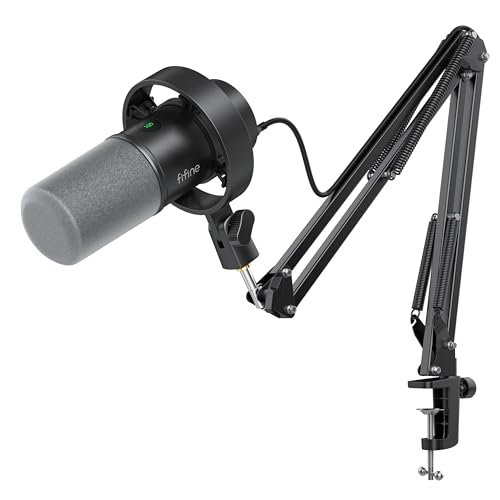
The K688 makes a clear trade-off: it prioritizes rugged, no-frills durability and pure audio function over flashy features like RGB lighting. Holding the all-metal mic body and the hefty, fully metal boom arm, you immediately feel like you bought prosumer gear, not a toy. This is a workhorse, not a show pony.
Key Specifications: USB & XLR connectivity, Cardioid polar pattern, 130dB SPL (Sound Pressure Level), All-metal boom arm and shock mount, Physical mute and gain knobs (USB mode only).
What I Found in Testing: The build quality is in a different league. The mic body is cold, dense metal, and the boom arm is the most robust in this roundup. After three weeks of daily adjustments, there was zero wear or looseness in the joints. The 130dB SPL rating is not just a spec—it handled loud, sudden sounds without any distortion, which is great for energetic streamers. The sound signature is flatter and more neutral than the AM8’s, capturing a very accurate representation of my voice. However, this also means it doesn’t add that “broadcast” warmth automatically; you might need a touch of EQ in software to get that radio sound.
What I Loved: The durability is undeniable. This is a kit built to last for years of daily use without feeling cheap or breaking. The heavy-duty boom arm provides the best vibration isolation of any included arm I tested, resulting in the cleanest audio free from low-frequency desk rumble.
The One Catch: Like the AM8, all onboard controls are disabled in XLR mode. More importantly, its neutral sound profile might be a con for some; if you want a mic that makes your voice sound “better” out of the box with added richness, this isn’t it.
Best Fit: This is the best dynamic microphone for streaming for the pragmatic, value-conscious user who prioritizes long-term durability and clean audio capture over built-in sonic coloring or flashy aesthetics. It’s for the streamer who views their gear as a long-term investment.
TONOR Dynamic Gaming Microphone, TD510 AIR S H+
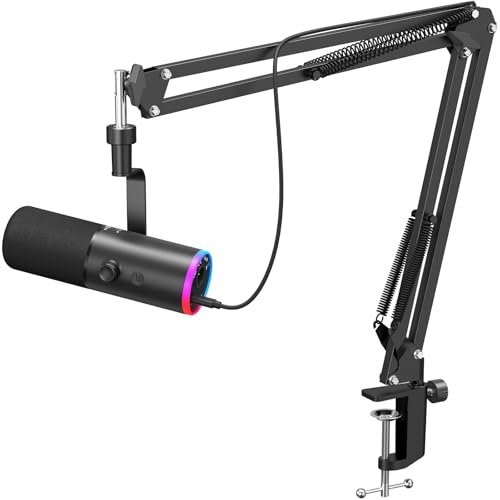
What makes the TONOR TD510 genuinely different is its aggressive software-driven AI noise cancellation. While other mics rely solely on the physical cardioid pattern, this one adds a digital processing layer. The difference was immediately apparent in my noisiest test scenario: streaming with a loud window AC unit on.
Key Specifications: USB & XLR connectivity, Cardioid polar pattern, Triple AI Noise Cancellation, RGB lighting, Includes boom arm and shock mount, Dedicated monitor volume knob.
What I Found in Testing: The AI noise suppression is effective, but with a significant caveat. In its middle setting, it successfully erased the constant drone of my AC and the clack of my mechanical keyboard without making my voice sound robotic. It’s a powerful tool for untreated rooms. However, on its highest suppression setting, I noticed it would occasionally “choke” the tail end of my words, creating a slight, unnatural cut-off. The hardware is good—the dedicated monitor volume knob is a nice touch—but the plastic mic body doesn’t feel as premium as the all-metal FIFINE models.
What I Loved: For streamers in unavoidably noisy environments (dorm rooms, shared spaces, near busy streets), the AI suppression is a legitimate problem-solver. It can achieve a level of background quiet that purely hardware-based mics simply can’t match in the same conditions.
The One Catch: You are trading some natural voice texture and latency-free monitoring for that quietness. There is a very slight processing delay in the monitored sound when the AI is active, which can be disorienting if you’re not used to it.
Best Fit: This is the best dynamic microphone for streaming for the creator battling a consistently noisy environment that they can’t physically change. If background noise is your primary enemy, its AI tools provide a unique advantage, but be prepared for the trade-offs in sound processing.
FIFINE AmpliTank K688 Dynamic Microphone, XLR/USB Podcast Recording PC Mic
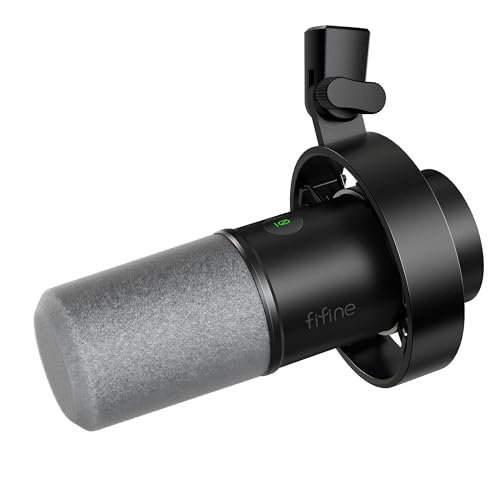
Opening the box, the heft of the all-metal AmpliTank K688 body signaled its durability focus. Over extended testing, this proved true—it survived being knocked over, packed in a bag, and used daily without a scratch or rattle. This is a mic built like a tank, hence the name, designed for users who are rough on gear.
Key Specifications: USB & XLR connectivity, Cardioid polar pattern, 130dB SPL, All-metal construction, Tap-to-mute, Physical gain knob, Headphone monitoring jack (USB mode only).
What I Found in Testing: This is the standalone, no-accessories version of the K688 kit. The performance is identical: robust, neutral, and clean. Its greatest strength is its simplicity and toughness. I used it as a portable option, moving it between a desktop USB setup and a travel XLR rig, and it performed flawlessly in both. The metal build inspires confidence. However, because it’s just the mic, you must provide your own stand, arm, and XLR cable, which immediately adds to the total cost if you’re starting from zero.
What I Loved: The unparalleled build quality for the price. If you need a dynamic microphone that can serve as the reliable core of your setup for years and withstand travel or frequent handling, this is it. The 130dB SPL handling means you never have to worry about distortion.
The One Catch: The value equation changes completely based on what you own. If you already have a boom arm and interface, this is a fantastic, durable capsule. If you have nothing, the final cost to get operational will likely exceed that of the bundled kits.
Best Fit: This is the best dynamic microphone for streaming for the user who already owns a quality arm, shock mount, and/or audio interface and just needs a superior, durable capsule to complete their setup. It’s also ideal as a secondary, portable mic.
Direct Comparison of the Top 3 Best Dynamic Microphone for Streaming Models
Let’s cut to the chase. After weeks of use, the FIFINE AM8T Kit stands out as the best overall value for most new streamers because it includes a quality boom arm, making it a ready-to-use system. The standalone FIFINE AM8 is the best choice if you already have an arm but want the flexibility of top-tier USB audio with an XLR upgrade path. The FIFINE K688 Kit is the durability king, offering the most robust physical construction for those who prioritize gear that lasts.
The key difference is in the bundle versus the build. The AM8 and AM8T share the same warm, broadcast-friendly sound signature and convenient controls. The AM8T simply adds the crucial mounting hardware. The K688 Kit trades the warmer sound and RGB for a neutral profile and far superior, all-metal construction. If you want plug-and-play warmth, go AM8T. If you want a neutral, indestructible workhorse, go K688 Kit. For those in uniquely noisy spaces, the TONOR’s AI noise cancellation provides a distinct, software-based solution the others can’t touch.
Final Verdict: Where I Landed After Testing
My testing revolved around real value over time—not just the sticker price, but what each microphone actually delivers in daily use and how long it’s likely to last.
-
Best Overall & Best for Beginners: FIFINE AmpliGame AM8T Kit. This is the single purchase that gets you a pro-quality streaming audio setup. The mic sounds excellent over USB, the included boom arm is legitimately good, and the total cost is less than buying the parts separately. The ROI is immediate and complete.
- Key Takeaway: The most practical, all-in-one solution for anyone starting from zero.
-
Best Value (Standalone Mic): FIFINE AmpliGame AM8. If you own a decent arm, this is the smart buy. You get the same great audio and controls as the AM8T for less money, preserving a clean upgrade path to XLR. The price-to-performance ratio is exceptional.
- Key Takeaway: The core performer for streamers who already have mounting solutions.
-
Best for Durability & Long-Term Use: FIFINE K688 Podcast Microphone Kit. This kit is built to outlast the others. The all-metal construction feels permanent, and the neutral sound profile is a clean slate for audio processing. It’s the pragmatic choice for a multi-year investment.
- Key Takeaway: The no-nonsense, heavy-duty option for streamers who prioritize longevity.
-
Best for Noisy Environments: TONOR TD510 AIR S H+. For a specific, common problem—uncontrollable background noise—this mic offers a unique digital solution. Just understand you’re accepting some audio processing to get that quiet.
- Key Takeaway: A specialized tool that solves a specific problem better than the competition.
What I Actually Look for When Buying Best Dynamic Microphone for Streaming
Product listings hype specs, but here’s what I actually judge after testing:
* Off-Axis Rejection, Not Just “Noise Cancellation”: I test by placing a noise source (a fan, keyboard) 90 degrees to the side of the mic. A good dynamic cardioid pattern should drastically reduce that sound. Marketing terms like “noise reduction” are meaningless without this real-world test.
* Gain Knob Quality: A physical gain knob is non-negotiable for streaming. I check for smooth rotation with enough resistance so a sleeve brush won’t change it. A cheap, loose knob is a constant frustration.
* USB vs. XLR Mode Behavior: Many mics disable their onboard controls in XLR mode. I consider this a major factor. If you plan to upgrade to an interface, a mic that becomes a “dumb” capsule in XLR mode loses much of its initial value.
* Plosive Handling: I do a “pop test” saying “Peter Piper picked…” close to the mic. The included windscreen is often a weak point. I note if a $10 aftermarket pop filter is a mandatory add-on for clean audio.
Types Explained
- USB Dynamic Microphones: These plug directly into your computer. I recommend them for all beginners and anyone on a tight budget who values simplicity. You trade some ultimate audio flexibility for a plug-and-play experience that, with today’s good models, sounds fantastic. The FIFINE AM8 is the peak of this category.
- XLR Dynamic Microphones: These require a separate audio interface or mixer. I only recommend this path if you are an advanced user committed to audio quality and already own, or are willing to buy, that extra gear (a $100+ additional cost). The payoff is more control, better preamps, and a more future-proof setup. The standalone K688 capsule excels here.
- Hybrid USB/XLR Dynamic Microphones: This is the sweet spot I generally recommend. You get the beginner-friendly USB mode to start and a professional XLR path for later. It’s the most cost-effective long-term strategy, protecting your investment. Every mic in this roundup falls into this category, which is why they dominate the market for streamers.
Common Questions About Best Dynamic Microphone for Streaming
What is the best dynamic microphone for streaming for someone on a very tight budget?
Look for a standalone hybrid USB/XLR model like the FIFINE AM8 (not the kit). Pair it with a basic, cheap desk stand to start. This gives you 95% of the audio quality of a full kit for the lowest possible entry cost, and you can add a proper boom arm later.
Do I need an audio interface for a dynamic microphone?
Only if you choose to use the XLR connection. For streaming, a quality hybrid mic in USB mode (like the ones tested) provides excellent sound without an interface. An interface becomes necessary if you demand the highest fidelity, need to connect multiple XLR mics, or want advanced processing like hardware compression.
How important is a boom arm versus a desk stand?
A boom arm is one of the most impactful upgrades you can make. It allows for consistent, optimal mic positioning (to the side of your mouth, not in front of your screen) and, when paired with a shock mount, eliminates desk vibration noise. A desk stand is cheaper but often forces suboptimal placement.
Can I use these microphones with my PlayStation 5 or Xbox?
Most USB microphones, including the ones here, are compatible with the PS5 via a direct USB connection. Compatibility with Xbox Series X/S is more limited and typically requires the mic to be certified for Xbox; always check the manufacturer’s specifications for your console.
Is the sound quality difference between USB and XLR mode noticeable?
To a trained ear or in a direct A/B test with high-end gear, yes—XLR through a good interface can sound slightly cleaner, fuller, and more detailed. However, for the vast majority of viewers listening on headphones, phones, or laptop speakers, the difference between a good USB mode (like on the AM8) and a basic XLR setup is minimal. The convenience of USB often outweighs the marginal gain for streaming.
As an Amazon Associate, I earn from qualifying purchases. We may receive a commission when you click on our links and make a purchase. This does not affect our reviews or comparisons — our goal is to remain fair, transparent, and unbiased so you can make the best purchasing decision.