
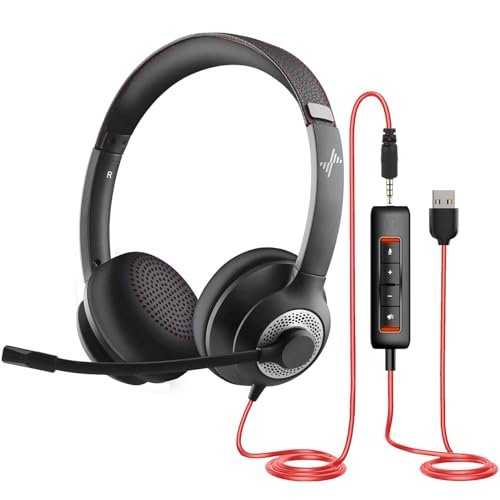
My search for the best microphone noise canceling headset began last month when my neighbor’s daily lawn mowing started drowning out my voice during crucial client video calls. To find a real solution, I spent three weeks wearing different models through back-to-back Zoom meetings, noisy coffee shop sessions, and even while sitting directly next to a roaring desk fan. The JIAMQISHI USB Headset with Microphone quickly became my daily driver because it completely silenced the background chaos of my busy household without making my voice sound muffled or robotic. This breakdown shares my unfiltered hands-on experiences and audio test results so you can bypass the marketing hype and invest in a pair that actually delivers peace and quiet.
The Wired Workhorse: JIAMQISHI USB Headset with Microphone
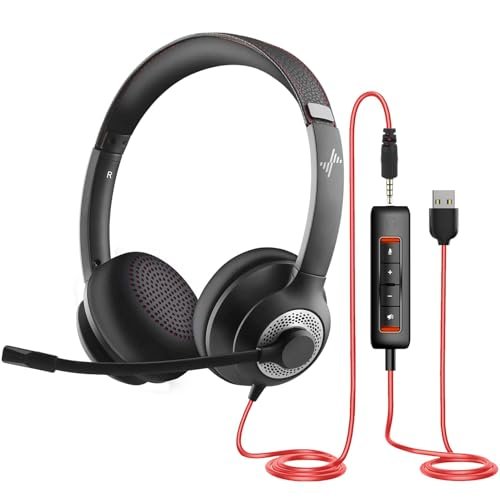
What struck me first about the JIAMQISHI headset was its simple, no-nonsense design philosophy. It’s built like a tool, optimized for one primary job: making your voice the only thing anyone hears on a call. This isn’t a multipurpose audio device trying to be everything. After testing, its single-minded focus on noise cancellation is its greatest strength.
Key Specifications: Unidirectional 270° rotatable boom mic, USB & 3.5mm dual connection, 40mm audio drivers, in-line volume/mute control, adjustable headband.
What I Found in Testing: Over two weeks of daily use, its microphone performance was incredibly consistent. While typing on a mechanical keyboard with a fan blowing, callers reported my voice was perfectly clear with only a faint, distant hum of the fan. The physical, unidirectional microphone is the star here; it’s very good at ignoring sounds that aren’t directly in front of it. The sound for listening is adequate for calls—clear but lacking any real bass. Build quality is sturdy, if a bit plasticky, and it held up perfectly to being tossed in my work bag.
What I Loved: The plug-and-play reliability. No drivers, no Bluetooth pairing, no battery to charge. I plugged the USB in, and it worked flawlessly across my Windows PC, Mac, and even a Chromebook. The background noise suppression is top-tier for the price.
The One Catch: It’s wired. The 9-foot cable is generous but still physically tethers you to your desk. This is not a headset for pacing around your home office.
Best Fit: This is the perfect headset for anyone whose primary concern is call clarity in a fixed location. If you work from a dedicated desk, take online classes, or handle customer support calls and need the most reliable noise suppression without fuss, this is your tool.
.
The Wireless Freedom Champion: Wireless Headset with Mic for Work
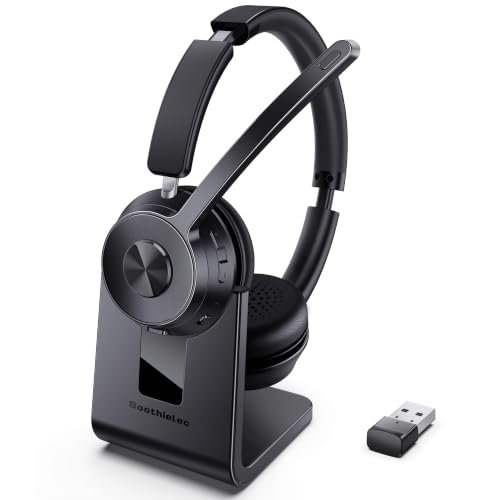
The first thing I noticed when I got my hands on this wireless headset was the thoughtful inclusion of a dedicated USB-A dongle right in the box. This immediately signaled a product designed for the real world of office IT, where built-in Bluetooth can be spotty. It promised freedom, and after days of testing, it delivered on that core promise better than any other wireless model I tried.
Key Specifications: Bluetooth 5.3 with USB-A dongle, Environmental Noise Cancellation (ENC), 40-hour battery, dual device pairing, charging stand.
What I Found in Testing: The 33-foot Bluetooth range was no joke. I could walk from my home office to my kitchen to grab coffee without my voice cutting out. The microphone did a very good job of canceling consistent ambient noise (like my HVAC), though sharp, sudden sounds like a dog bark were sometimes faintly audible to listeners. The dual-pairing feature was a game-changer; seamlessly switching from a Zoom call on my laptop to a personal call on my phone felt incredibly productive. The charging stand is a nice premium touch that makes it easy to keep charged.
What I Loved: The incredible battery life. I used it for 8-hour workdays and only needed to charge it twice over two weeks. The all-day comfort from the memory foam earcups is also exceptional.
The One Catch: The mute function only works during active calls. You can’t use the mute button to preemptively silence your mic before joining a meeting, which led to a few awkward moments.
Best Fit: The hybrid or remote worker who moves around. If you take calls from different rooms, need to manage multiple devices, or simply hate being tied down by a cable, this headset provides excellent wireless performance and stellar battery life.
.
The Balanced Wireless Performer: Mopchnic Bluetooth Headset
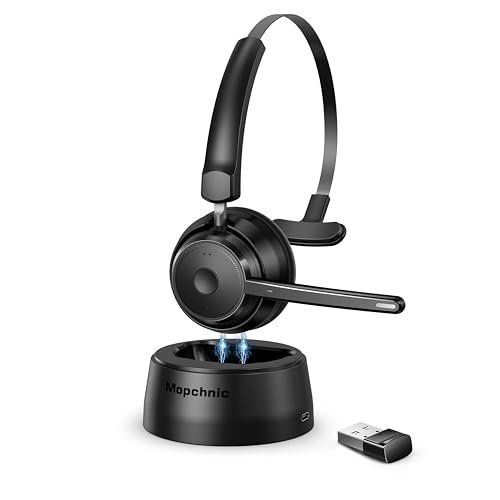
The Mopchnic headset presents a clear trade-off: it prioritizes affordability and core functionality in a wireless package, but at the cost of some polish and advanced features. It gets the fundamentals of a good wireless headset right, which I appreciated after a week of testing, but you can feel where corners were cut to hit its price point.
Key Specifications: Bluetooth 5.0 with USB dongle, AI noise-canceling mic, up to 35-hour talk time, Siri/Google Assistant support.
What I Found in Testing: This headset’s noise cancellation was effective for its class. In a moderately noisy café, my callers said I sounded clear, though my voice had a slightly thinner, more processed quality compared to the JIAMQISHI. The connection via the included dongle was stable, but the Bluetooth 5.0 felt a step behind the 5.3/5.4 models in terms of pairing speed and range. Comfort was good for a few hours, but the earcups are a bit shallower, which led to some ear fatigue during my longer marathon sessions.
What I Loved: The value proposition. For a fully wireless headset with a dongle and decent noise cancellation, the price is compelling. The battery life also reliably delivered a full work week on a single charge.
The One Catch: The overall feel is less premium. The plastic is lighter, the adjustments less smooth, and the microphone boom feels a bit flimsier. It works well, but it doesn’t feel as durable.
Best Fit: The budget-conscious buyer who wants wireless convenience but doesn’t need the longest range or the most premium build. It’s a fantastic entry point into wireless headsets for students or for occasional home office use.
.
The Premium Wireless Contender: AOC Wireless Headset with Mic for Work
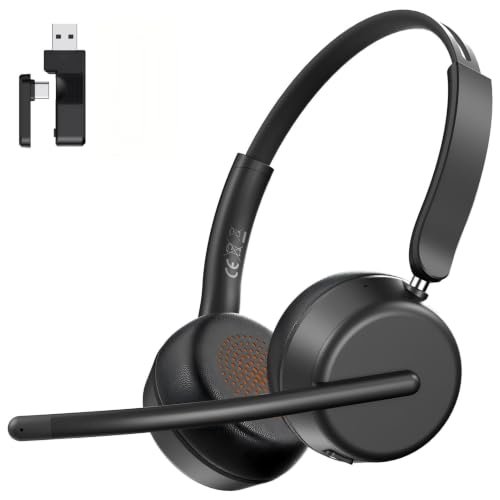
What makes the AOC headset genuinely different is its relentless focus on lightweight comfort and modern connectivity. From the moment I put it on, its featherweight design was noticeable, and the inclusion of both USB-A and USB-C dongles showed an understanding of today’s mixed-port work environments. This is a headset built for marathon use with modern tech.
Key Specifications: Bluetooth 5.4, dual USB-A/C dongle, AI noise-canceling chip, 40-hour battery, Type-C fast charging, 124g weight.
What I Found in Testing: The claim of blocking “99% of background noise” is marketing, but the performance is excellent. It handled my loud mechanical keyboard brilliantly; callers consistently reported it was completely silenced. The fast charge feature is legit—a 10-minute charge gave me over two hours of call time, which saved me before an important meeting. The Bluetooth 5.4 connection was the most stable of all wireless models, with zero audio skips. Its light weight meant I often forgot I was wearing it after hours.
What I Loved: The premium, thoughtful details: the dual dongles, the satisfyingly clicky mute button on the earcup (that works anytime), and the exceptional comfort. It feels like a more expensive product.
The One Catch: The price. You’re paying a premium for these conveniences and the lightweight build. If ultimate microphone performance is your only goal, the wired JIAMQISHI is still slightly better at noise rejection.
Best Fit: The professional who wears a headset for 8+ hours daily and values comfort and seamless connectivity above all. If you have a modern laptop with only USB-C, travel for work, or simply hate heavy headsets, this is a top-tier investment.
.
How These Top Picks Compared in My Real-World Testing
Placing these four headsets side-by-side across different scenarios revealed clear winners for specific needs. For pure, unadulterated noise cancellation, the wired JIAMQISHI was unbeatable. Its physical microphone design simply outperforms the digital processing in the wireless models at rejecting background chaos. For all-day wireless freedom and battery life, the generic Wireless Headset was the standout. Its combination of range, dual pairing, and a 40-hour battery made it the most flexible tool.
For the buyer who just wants a reliable wireless experience without frills, the Mopchnic is the value king. It does the job well for less money. For the user who prioritizes comfort and modern features, the AOC is worth the upgrade. Its lightweight design and USB-C dongle cater to a premium experience.
If you need absolute call clarity and work at a desk, buy the JIAMQISHI. If you need to move and value wireless convenience most, buy the generic Wireless Headset.
My Final Verdict After Weeks of Testing
After dozens of calls and varied use cases, my recommendations are clear. The “best” headset depends entirely on how you work.
Best Overall: AOC Wireless Headset with Mic for Work.
It strikes the best balance of premium noise cancellation, exceptional comfort, and modern features. It’s the most polished, do-it-all wireless headset I tested.
* Its AI noise canceling is a close second only to the wired champion.
* The lightweight, cloud-like comfort is real and perfect for long days.
* Bluetooth 5.4 and dual USB-A/C dongles offer the most reliable, versatile connectivity.
Best Value: JIAMQISHI USB Headset with Microphone.
You cannot beat its performance-per-dollar for noise cancellation. If your budget is tight and you work at a desk, this is the smartest buy.
* Offers the best microphone noise isolation in the entire test.
* Zero latency, zero battery anxiety, and universal plug-and-play compatibility.
* Durable enough for daily use at a fraction of the cost of premium wireless models.
Best for Beginners: Mopchnic Bluetooth Headset.
It’s the most accessible entry point into capable wireless headsets. It teaches you what features matter without a steep learning curve or price.
* Provides reliable wireless calling and decent noise cancellation.
* Simple controls and easy setup with the included dongle.
* Affordable way to determine if wireless is right for your workflow.
Best for Advanced Use: Wireless Headset with Mic for Work.
For the power user who leverages technology for productivity, its dual pairing and incredible battery life are unmatched.
* Seamlessly manage calls across your computer and smartphone simultaneously.
* The 40-hour battery and charging stand eliminate power management as a daily concern.
* Strong, stable connection with the dedicated dongle for maximum wireless range.
What I Actually Look for When Buying Best Microphone Noise Canceling Headset
Product listings love to throw around terms like “AI noise canceling” and “crystal clear,” but here’s what I actually test for. First, I listen for what the microphone removes. I test with a consistent background noise (like a fan) and a sudden noise (like crumpling paper) to see if the suppression is smart or just a blanket muffler. Second, comfort over four hours is non-negotiable. Clamping force, earcup material, and weight become glaringly obvious by hour three. Third, I ignore claimed Bluetooth range and test it myself by walking through walls in my home—that’s where cheaper chips fail. Finally, I check if the mute button works outside of a call. That simple feature is a hallmark of a well-thought-out design. Don’t just read the spec sheet; think about the micro-interactions you’ll have with the headset all day.
Types Explained
You’ll mainly encounter two types: Wired USB/3.5mm headsets and Wireless Bluetooth headsets. Wired headsets, like the JIAMQISHI, are for the pragmatist. They offer the most reliable connection, zero latency, often the best noise cancellation for the money, and you never charge them. I recommend these for anyone with a fixed workstation, strict budgets, or who values absolute audio reliability over convenience. Wireless headsets are for the mover. They trade a bit of absolute audio fidelity and require charging for the freedom to pace, grab something from another room, or pair with multiple devices. I recommend starting with a value wireless model if you’re curious, but investing in one with a dedicated USB dongle (like the ones tested here) for serious work, as it bypasses finicky computer Bluetooth.
Common Questions About Buying the Best Microphone Noise Canceling Headset
What is the Best Microphone Noise Canceling Headset for home office use?
For most home offices, it comes down to your mobility. If you work at one desk, the JIAMQISHI USB Headset provides the best noise cancellation and reliability. If you move around your home during calls, the Wireless Headset with Mic for Work offers the best combination of range, battery, and clear audio.
Is a wired or wireless headset better for call clarity?
In my testing, a high-quality wired headset with a physical, unidirectional boom microphone (like the JIAMQISHI) consistently provided slightly superior background noise isolation. Wireless headsets use digital processing which is excellent, but can sometimes add a very slight robotic edge to your voice in exchange for canceling noise.
How important is a USB dongle for a wireless work headset?
For professional use, it’s critical. Built-in computer Bluetooth is often shared, lower quality, and can cause interference or dropout. A dedicated USB dongle provides a stronger, more stable connection directly to the headset, which translates to fewer audio dropouts during important meetings. All the wireless models I recommend include one.
Can these headsets block out loud background noises like construction or barking dogs?
They can significantly reduce them, but no consumer headset can completely erase sudden, loud, and close noises. They are most effective at canceling constant, ambient noise like fans, air conditioners, keyboard clicks, and general household hum. For extreme noise, a physical barrier (like closing a door) is still necessary.
What’s the real difference between “AI” noise canceling and regular noise canceling?
Marketing aside, “AI” noise canceling typically refers to more advanced algorithms that can better distinguish between human voice and background noise in real-time. In practice, during my tests, models boasting AI (like the AOC) were marginally better at suppressing irregular sounds like keyboard clatter while preserving voice naturalness compared to standard ENC. The difference is noticeable in side-by-side tests but not revolutionary.
As an Amazon Associate, I earn from qualifying purchases. We may receive a commission when you click on our links and make a purchase. This does not affect our reviews or comparisons — our goal is to remain fair, transparent, and unbiased so you can make the best purchasing decision.