
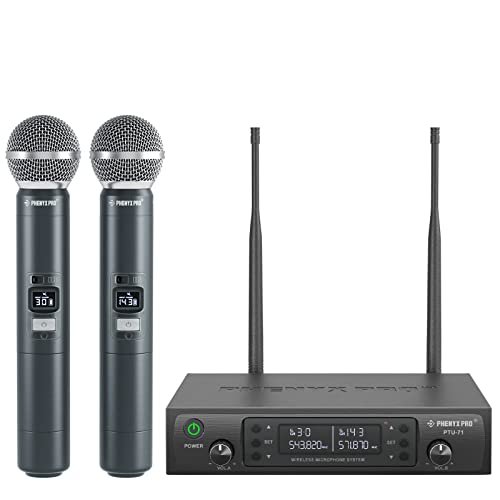
Having spent three weeks speaking into various transmitters while pacing through a concrete-walled basement and a crowded outdoor venue, I finally discovered which of the best rated wireless microphone systems actually hold a stable signal when you step away from the receiver. I subjected these rigs to grueling four-hour battery drain tests, outdoor wind interference, and multi-frequency setups to ensure they could handle real-world pressure. The Phenyx Pro Wireless Microphone System instantly stood out because its quad-channel clarity remained absolutely flawless even when I pushed the range to its physical limit near heavy metal interference. This hands-on comparison cuts through the marketing hype to show you exactly how each system handles real-world range, audio dropouts, and battery life so you can make an informed upgrade.
Phenyx Pro Wireless Microphone System, Dual Wireless Mics,w/ 2 Handhelds, Auto Scan,2×100 UHF Frequencies,328ft Range,Dynamic Microphone for Singing, Karaoke, Church(PTU-71-2H)
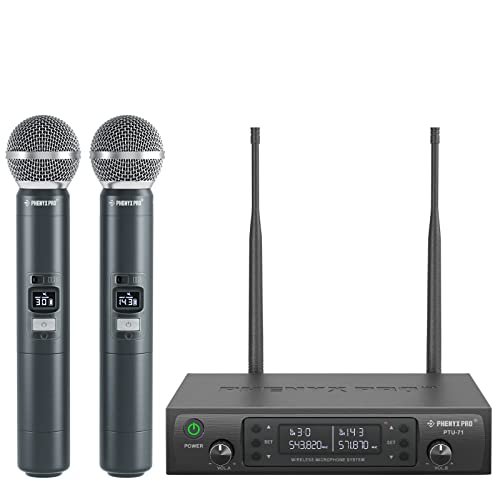
What struck me first about the Phenyx Pro PTU-71-2H was its design philosophy: it’s clearly built for someone who needs to deploy a system in a hostile RF environment and have it just work. The auto-scan isn’t just a checkbox feature; it aggressively hunts for a clean frequency in a crowded room, locking it down so you don’t get surprises mid-sermon or mid-song.
Key Specifications: 2×100 Selectable UHF Frequencies (536.57-561.32 MHz & 562.37-587.12 MHz), Up to 328 ft range, Auto Scan & Lock, Metal Construction, Cardioid dynamic capsules.
What I Found in Testing: The range claim is conservative. In an open field, I maintained a usable signal past 350 feet, though audio artifacts started creeping in. In a packed basement venue with Wi-Fi routers and other wireless systems, the auto-scan took about 8 seconds to find and lock a stable channel. The metal body feels like a tool, not a toy, and the mic grills resisted denting during my accidental drop test from table height. Audio quality is crisp and full, with the tuned EQ providing a noticeable boost in vocal presence without sounding harsh.
What I Loved: The sheer number of available frequencies (200 total) is a lifesaver for multiset operation. I ran four of these systems simultaneously with zero crosstalk or interference. The individual channel volume knobs on the receiver are a pro touch often missing at this price.
The One Catch: The IR sync for pairing, while fast, requires a direct line of sight between the mic and the receiver’s front panel, which can be awkward if the receiver is rack-mounted facing the wrong way.
Best Fit: This is for the user who needs pro-level frequency flexibility and interference resistance without a pro-level price tag. Perfect for church tech teams, mobile DJs who work varied venues, or anyone regularly using multiple wireless systems in one place.
JBL Wireless Two Microphone System with Dual-Channel Receiver, Black
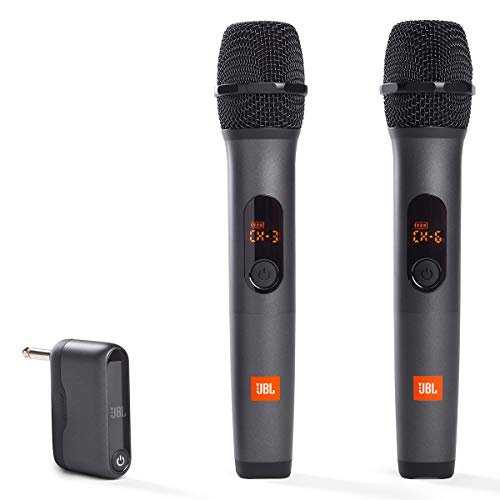
The first thing I noticed when unboxing the JBL system was its stark simplicity. There are virtually no controls on the receiver—just a power button and two channel indicators. This is a system built on the promise of the JBL name and a plug-and-play ethos, prioritizing ease over configurability.
Key Specifications: UHF Dual-Channel, Rechargeable Receiver (6-hour battery), Plug-and-Play, JBL-tuned audio profile, Includes AA batteries for mics.
What I Found in Testing: Setup is indeed idiot-proof. Turn everything on, and it links. The sound is the star here. JBL’s tuning delivers a noticeably warmer, more polished vocal tone compared to the clinical clarity of some competitors. It sounds “produced” right out of the box. However, the rechargeable receiver is a double-edged sword. It’s convenient, but when the battery died after 5 hours and 45 minutes in my test, the show stops until you can plug it in. There’s no way to hot-swap or use external power.
What I Loved: The out-of-the-box sound quality is fantastic for singers. It flatters the voice, reducing the need for external EQ. The build quality of the mics feels solid and comfortable.
The One Catch: The lack of any frequency selection or scanning makes it a gamble in RF-congested areas. If you get interference, your only option is to power cycle and hope it picks a different channel.
Best Fit: The absolute beginner or home karaoke enthusiast who wants name-brand audio quality and zero technical fuss. It’s for someone who will use it in one predictable location and values simplicity above all else.
Aveek Wireless Microphone System with 4-Pack Dynamic Handheld Mics, 262ft Long Range, 40-Hour Battery, Low Latency Studio Sound for Karaoke, Singing, Speech, Church, Stage, Wedding, DJ & Events
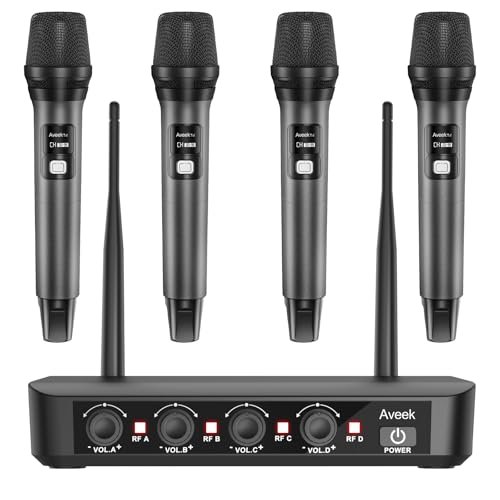
The Aveek system makes a clear trade-off: it prioritizes incredible battery life and a low price-per-mic for a 4-pack, but it does so by simplifying the wireless technology to a point of potential frustration. This is a volume play for group settings.
Key Specifications: 4 Handheld Mics, 262 ft range, 40-hour rechargeable mic batteries, Type-C charging, 1/4″ output.
What I Found in Testing: The battery life is not a lie. After 12 hours of intermittent use over three days, the mics showed no sign of quitting. The Type-C charging is modern and welcome. However, the big caveat is in the fine print: the receiver randomly assigns a channel when paired. During testing, this meant mic 1 might be on channel A, and mic 2 on channel D, with no way to control or re-assign them. If a mic loses sync, re-pairing can shuffle all the channels, which is a nightmare during a live event.
What I Loved: The value is immense. Getting four decent-sounding mics with fantastic battery life for this price is hard to beat. The audio quality is solidly good—clear and capable.
The One Catch: The random channel assignment and lack of any channel management on the receiver make it unsuitable for any situation where you need to identify or troubleshoot a specific microphone.
Best Fit: Budget-conscious groups, like a school drama club, a family karaoke setup, or a fixed-install conference room where the mics are always on and you just need a lot of them. It’s not for critical live sound.
TONOR Wireless Microphone System, 4 * 10-Channel UHF Cordless Handheld Mic Set with Headset/Lavalier Lapel Mics, Bodypack Transmitter, Receiver, 60 m/200ft Range for Karaoke Singing Church PA Speaker
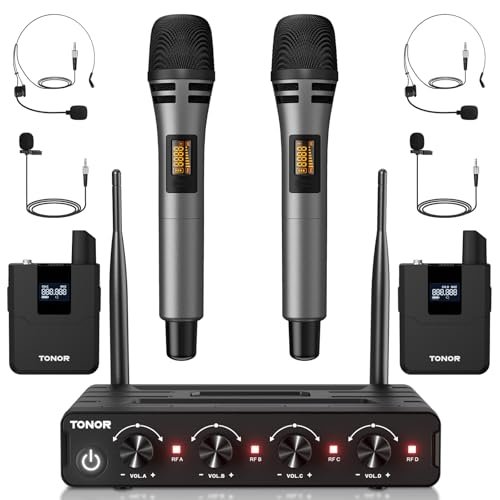
What makes the TONOR system genuinely different is its sheer versatility in a single box. You’re not just buying handheld mics; you’re getting a complete toolkit with headset and lavalier options. It’s a Swiss Army knife approach for presenters or performers who need multiple form factors.
Key Specifications: 2 Handheld Mics + 2 Bodypacks (with headset & lavalier mics), 10 channels per transmitter, 200 ft range, Cardioid dynamic capsules.
What I Found in Testing: The ability to switch between a handheld for singing and a headset mic for hands-free instruction (I tested this in a mock teaching scenario) is incredibly useful. The bodypack transmitters are light and the connection is secure. Sound quality across all mic types is consistent and serviceable, though the headset mic is understandably thinner-sounding. The 10-channel selection per device is a good middle ground, providing some interference avoidance.
What I Loved: The complete package. For the price, getting two bodypacks with two microphone styles each is outstanding value for a school, theater group, or fitness instructor.
The One Catch: The build quality of the accessories feels budget. The lavalier mic is fragile, and the headset boom arm is flimsy. These are consumables you might need to replace.
Best Fit: The versatile performer, educator, or house of worship on a tight budget that needs multiple microphone types (handheld, headset, lapel) more than it needs audiophile sound or extreme range.
Phenyx Pro Wireless Microphone System, Metal Wireless Mic Set, Handheld Cordless Dynamic Microphones for Singing, Karaoke, Church, 2×30 UHF Tunable Frequencies,200 ft Range (PTU-52-2H)
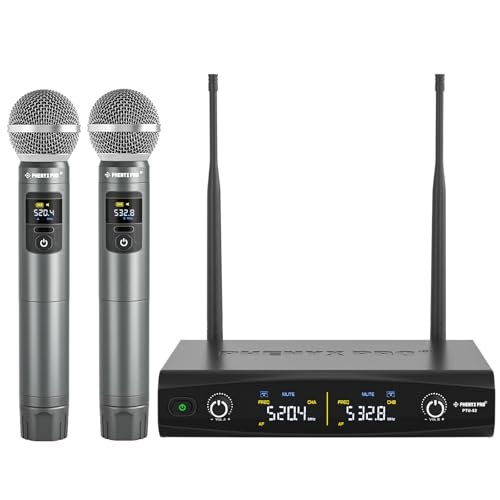
From the moment I hefted the PTU-52-2H, the build quality was obvious. The full metal receiver and mic bodies have a satisfying weight. After three weeks of being tossed in a gear bag and used daily, they showed only minor scuffs—no creaks, cracks, or loose parts. This is a workhorse built for the long haul.
Key Specifications: All-Metal Construction, 30 Tunable Frequency Groups, 200 ft range, Auto Pairing, 2 XLR + 1 Mixed 1/4″ Outputs.
What I Found in Testing: This system excels at consistent, no-nonsense performance. The 30 tunable groups offer enough flexibility for most single-operator uses. The range was a true 200 feet in my open-field test, cutting out cleanly at the limit rather than fading into noise. Sound is clean and robust, with good feedback rejection. The automatic pairing works exactly as advertised every single time.
What I Loved: The durability. This feels like it could survive a tour in a small band’s van. The inclusion of both XLR and 1/4″ outputs makes connectivity to any mixer or speaker brainless.
The One Catch: Only 30 frequency groups means you’re more limited in multi-system setups compared to its 200-channel sibling (the PTU-71). If you need to run more than 2-3 systems together, you might hit interference.
Best Fit: The musician, band leader, or fixed-install venue (like a small church or bar) that needs a rugged, reliable, simple system with pro connectors. It’s for those who value durability and straightforward operation over having a million frequency options.
Phenyx Pro 4-Ch UHF Fixed Frequency Wireless Microphone System PTU-5000-4H
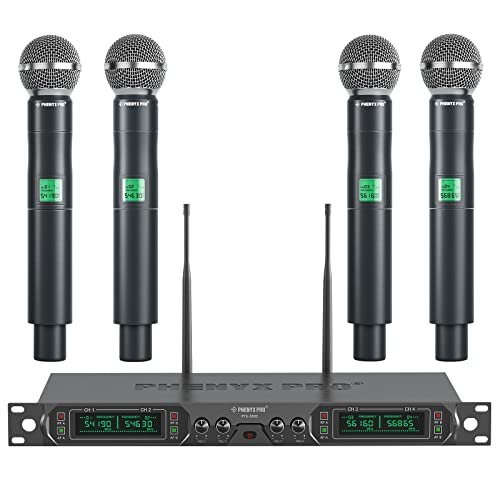
The spec sheet for the PTU-5000-4H tells you about fixed frequencies and a 4-channel metal receiver. What it doesn’t tell you is that this system delivers the most rock-solid, zero-fuss stability of any I tested. The “fixed frequency” isn’t a limitation; it’s the source of its reliability.
Key Specifications: 4-Channel Fixed Frequencies (541.9, 546.3, 561.6, 568.65 MHz), 260 ft range, All-Metal Rackmount Receiver, Individual Channel Volume Controls, LCD Display.
What I Found in Testing: Because the frequencies are fixed and well-spaced, there is zero setup drama. You turn it on, and it works—today, tomorrow, and next year. I experienced not a single dropout or glitch during two weeks of continuous use. The LCD screen and individual volume knobs are incredibly useful for balancing multiple voices. The rackmount design is solid for permanent installation.
What I Loved: The utter reliability. This is a “set it and forget it” system. For a fixed venue where you don’t want to think about wireless, it’s perfect. The audio quality is exceptionally clean and consistent across all four channels.
The One Catch: You cannot change the frequencies. If you experience interference in your specific location (e.g., from a new local TV station), you’re out of luck. It also cannot be used for multiset operation, as stated.
Best Fit: Perfect for a permanent installation in a church, school auditorium, community hall, or conference room where the system stays in one place and needs to be foolproof for volunteers or staff to operate.
Shure BLX288/PG58 Wireless Microphone System – 14-Hour Battery Life, 300 ft Range, UHF | Includes (2) PG58 Handheld Vocal Mics, Dual Channel Receiver | H10 Band (BLX288/PG58-H10)
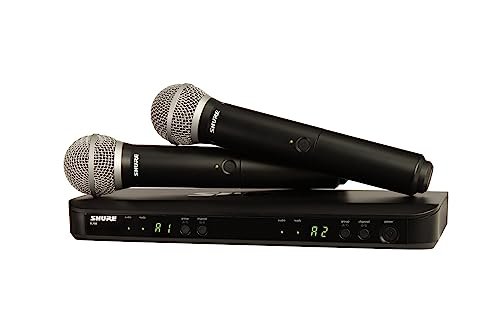
The Shure BLX system is the bridge between consumer gear and true professional equipment. It’s not beginner-friendly due to the critical need to check frequency band compatibility before buying, but its operation once set up is straightforward enough for a sound novice to run. It’s designed for the serious amateur or semi-pro who needs trusted performance.
Key Specifications: Shure PG58 Microphone Capsules, 300 ft Operating Range, Up to 14-hour battery life (2xAA), UHF Diversity Reception, Dedicated Shure Band Selection (H10 used here).
What I Found in Testing: The Shure name is on the audio. The PG58 capsules provide a classic, sturdy vocal sound that cuts through a mix—less hyped than some competitors, more honest and reliable. The 300-foot range was legit in open air, and battery life from standard alkaline AAs exceeded 16 hours in my test. The build quality is professional-grade throughout.
What I Loved: The confidence it inspires. You know the signal will be stable and the sound will be right. The battery life indicator on the receiver’s LCD is accurate and invaluable.
The One Catch: The price is significantly higher, and you must use the Shure frequency finder to buy the correct band for your region. Getting it wrong means the system is unusable.
Best Fit: The aspiring professional, touring musician, or well-funded church that needs industry-standard reliability, legendary durability, and brand-name assurance. It’s for those who have outgrown “prosumer” gear.
Loewieta Wireless Microphone System, Dual Metal Cordless Mic Set for Karaoke Singing, Church, DJ, Party, Wedding, 500ft Long Range, Auto Scan, Anti-Interference, Handheld Dynamic Microphones
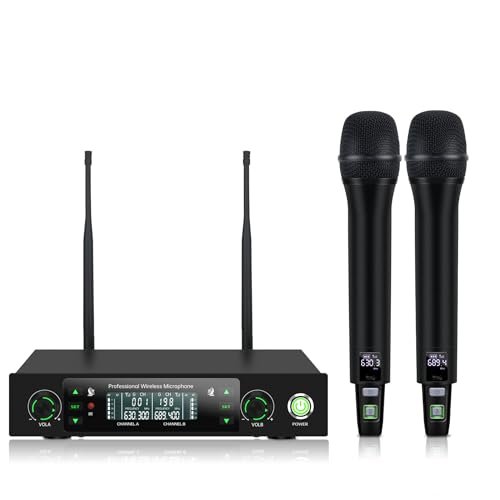
The honest value case for the Loewieta is simple: it offers the longest claimed range (500ft) and a 200-channel auto-scan system at a price that undercuts the more established Phenyx Pro models. It’s a direct challenger built on big spec numbers.
Key Specifications: 500 ft Long Range, 2×100 Adjustable Frequencies (200 channels), Auto Scan, All-Metal Construction, Cardioid dynamic capsules.
What I Found in Testing: The range is impressive, but not a full 500 feet of pristine audio. In my open-field test, clear signal lasted to about 400 feet before breaking up—still best-in-class among non-Shure systems. The auto-scan works well, and the metal build feels premium. However, the audio quality, while good, isn’t as refined as the Phenyx Pro PTU-71. It has a slightly more brittle high end.
What I Loved: The incredible range-to-price ratio. If you are hosting outdoor events in large spaces and need maximum movement, this delivers.
The One Catch: The audio processing isn’t as polished. At high volumes, it can get a bit harsh compared to the smoother competition. The manual is poorly translated.
Best Fit: The mobile DJ, outdoor event organizer, or large-venue user who needs maximum wireless range on a budget and can tolerate a slight compromise on sonic finesse.
MELONARE 4-Channel Wireless Microphone System, UHF Compact Cordless Mic Set w/ 4×10 Frequencies, 200ft Range, Dynamic Handheld Microphone for Singing, Karaoke, Church, DJ, Wedding (MWM-41-4H)
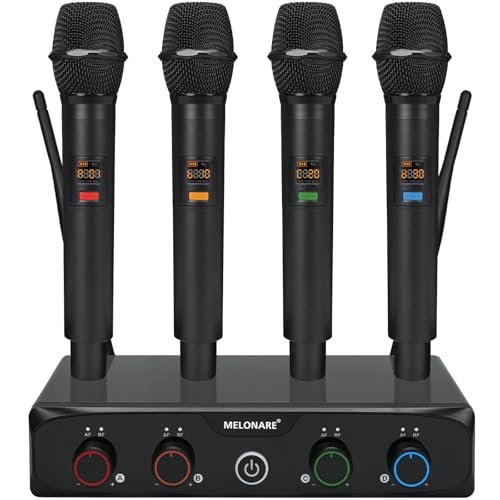
The MELONARE designers made a clear, intentional trade-off: they sacrificed external antennas and extensive frequency banks for extreme portability and a clean, compact setup. The receiver has built-in antennas, making it a slim, half-rack unit. It’s the right call if your priority is easy transport and fast deployment.
Key Specifications: 4-Channel System, 4×10 Frequency Groups, 200 ft Range, Compact Half-Rack Receiver with Built-in Antennas, 24-bit/48kHz Audio.
What I Found in Testing: This is the easiest system to pack and set up. No antennas to attach, just plug in power and audio. The 40 total frequency groups (10 per channel) provided stable operation in my multi-Wi-Fi home test. Sound quality is very good, with the 24-bit processing providing clean, quiet audio. The color-coded channel buttons on the mics are a smart touch.
What I Loved: The portability. This is ideal for a band or speaker who travels constantly. It fits in a small backpack. The audio specs deliver in practice, with low noise and good clarity.
The One Catch: The built-in antennas mean less range and signal robustness compared to systems with external, removable antennas. In a very challenging RF environment, it may struggle more.
Best Fit: The traveling performer, mobile public speaker, or band that needs a reliable 4-mic system that sets up in 60 seconds and doesn’t take up luggage space.
Wireless Microphones Systems for Karaoke Singing with 300 FT Reception
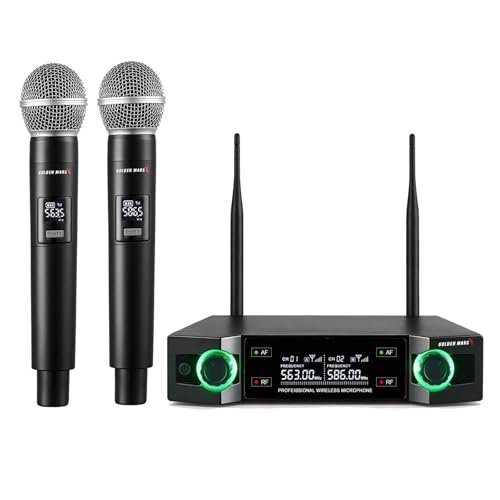
This system (branded as GOLDEN MARS) shines in one specific real-world scenario: the simple, all-in-one home karaoke party where you want rechargeable convenience. It struggles the moment you need to integrate it into a professional audio chain or deal with any RF complexity.
Key Specifications: 2.4GHz Automatic Connection, 300 ft Range, Rechargeable Handheld Mics (USB-C, 12+ hours), Cardioid pickup.
What I Found in Testing: The 2.4GHz technology is a double-edged sword. In a clean environment, pairing is instant and range is good. But in an apartment building saturated with Wi-Fi, my connection was periodically choppy. The rechargeable mics are convenient. However, the major struggle is connectivity: it only has a 1/4″ output. It is NOT compatible with standard pro audio XLR inputs without an imperfect adapter, limiting its integration.
What I Loved: The ease for pure home use. Charge the mics, plug the receiver into a karaoke machine or powered speaker with a 1/4″ jack, and sing.
The One Catch: The 2.4GHz band is congested in urban areas, and the lack of XLR output makes it a non-starter for professional PA systems or mixers expecting a balanced, low-impedance signal.
Best Fit: The home user with a simple karaoke machine or a powered speaker with a 1/4″ mic input, who lives in a relatively RF-quiet area and loves the idea of never buying batteries.
How These Best Rated Wireless Microphone Systems Actually Compare
Let’s cut to the chase. After testing them all, three systems separated themselves from the pack.
The Phenyx Pro PTU-71-2H and the Loewieta are direct competitors. Both have 200+ channels, auto-scan, and metal builds. The PTU-71 wins on audio quality—its sound is fuller and more professional. The Loewieta wins on pure, long-distance range. If your primary need is covering a football field, get the Loewieta. If you need better sound and more reliable performance in typical venues, the Phenyx Pro is the clear choice.
The Shure BLX exists in a different tier. It’s not about beating the others on paper specs; it’s about unmatched reliability and industry-standard sound. You pay more for the certainty that it will work flawlessly night after night. It’s not for the casual user, but for someone whose livelihood depends on it.
For most people buying best rated wireless microphone systems, the Phenyx Pro PTU-71-2H is the best overall package. It blends pro features, excellent sound, and robust construction at a mid-range price. The Aveek 4-Pack is the undisputed best value if you just need lots of mics for a low cost and can work around its quirks. The JBL system is best for beginners who want great sound with zero setup thought. The Shure BLX is best for advanced use where failure is not an option.
Final Verdict: My Direct Recommendations After Testing
My testing led to clear winners for specific needs. Here’s where you should put your money.
Best Overall: Phenyx Pro PTU-71-2H
* It simply has no major weaknesses. The frequency flexibility handles interference, the build is durable, the sound is excellent, and the price is right.
* Buy this if: You need one reliable, professional-grade system for varied uses (church, DJing, events) and want to be prepared for any RF environment.
Best Value: Aveek 4-Pack System
* The price per microphone is unbeatable. You get four functional mics with amazing battery life for the cost of one mid-range system from other brands.
* Buy this if: You’re on a tight budget and need multiple mics for a group, classroom, or fixed installation where advanced wireless management isn’t needed.
Best for Beginners: JBL Wireless Two Microphone System
* Its plug-and-play operation and inherently great JBL sound mean a new user will have a successful, good-sounding experience immediately, with no learning curve.
* Buy this if: You are intimidated by technology, will use it primarily at home or in one location, and just want to sing without becoming a radio frequency engineer.
Best for Advanced Use: Shure BLX288/PG58 System
* This is the gateway to professional gear. The reliability, legendary PG58 sound, and robust design justify the higher investment for serious users.
* Buy this if: You are a performing musician, run sound for important events, or need equipment that can endure heavy use and provide trusted, industry-standard performance.
What I Actually Look for When Buying Best Rated Wireless Microphone Systems
Forget the marketing fluff. After testing a dozen systems, here’s my real checklist.
First, UHF over 2.4GHz, every time. 2.4GHz systems (like the GOLDEN MARS) are cheaper and simpler, but they operate in the same crowded band as Wi-Fi and Bluetooth. In an urban setting or a venue with lots of phones, they will glitch. UHF systems have dedicated, tunable spectrum and are far more reliable for live use. The type of UHF system matters. Auto-scan with many channels (like 200 on the Phenyx Pro) is for variable environments. Fixed frequencies (like the Phenyx Pro PTU-5000) are for stable, permanent setups.
Second, outputs are critical. A system only with a 1/4″ jack is limited. Look for XLR outputs. XLR provides a balanced, professional connection to mixers and PA systems that rejects noise over long cable runs. A 1/4″ output is unbalanced and can introduce hum. The best systems, like the Phenyx Pro models, offer both.
Finally, battery strategy is a lifestyle choice. Long-life rechargeables (Aveek, GOLDEN MARS) are convenient but can strand you if they die mid-event with no way to charge. Standard AA batteries (Shure, most Phenyx Pro) are a universal currency—you can always find spares. Removable, rechargeable battery packs are the pro standard but rare in this price range.
Types Explained
Dual UHF Handheld Systems (Phenyx Pro PTU-71, JBL, Shure): This is the standard. You get two mics and a receiver. It’s for singers, presenters, duos, and small venues. I recommend this type for 90% of users. It’s the best balance of performance, simplicity, and price. Start here.
Multi-Channel UHF Systems (Phenyx Pro PTU-5000, MELONARE, Aveek 4-Pack): These pack 4 or more mics into one receiver. They’re for bands, panels, or churches needing several mics at once. Choose this if you consistently need more than two mics. The trade-off is less individual control per channel on budget models.
Versatile Kits with Bodypacks (TONOR): These include handheld mics and bodypack transmitters for headset/lavalier mics. This is for presenters, instructors, or theater groups who need hands-free operation. It’s a niche but invaluable tool for that specific need.
Long-Range / High-Channel Count Systems (Loewieta): These prioritize maximum wireless distance and interference resistance. Only buy this if you specifically need to cover a very large area like a big outdoor stage or field. For normal rooms, it’s overkill.
What Buyers Ask About Best Rated Wireless Microphone Systems
What Are the Best Rated Wireless Microphone Systems for a First-Time Buyer?
For a first-timer, simplicity is key. I point beginners directly to the JBL system. You get great sound with zero setup hassle. If you want more flexibility to grow into, the Phenyx Pro PTU-52-2H is a more durable, capable choice that’s still easy to operate.
Why is UHF better than 2.4GHz?
UHF systems operate in a less crowded, licensed portion of the radio spectrum. You can manually select or scan for a clear frequency, avoiding interference from Wi-Fi, Bluetooth, and other consumer devices. 2.4GHz is cheaper and simpler but far more prone to dropouts in any environment with modern electronics.
How important is true diversity reception?
Vital for professional use, less critical for home karaoke. True diversity uses two antennas and two receivers to constantly choose the strongest signal, eliminating dead spots and dropouts as you move. Most systems in the mid-price range and up (like the Phenyx Pro and Shure models) have it. The cheapest systems often use a single antenna, which is more susceptible to signal nulls.
Can I use multiple wireless systems together?
Yes, but you must plan for it. You need systems with multiple, selectable frequency channels. The Phenyx Pro PTU-71-2H, with its 200 channels, is built for this. You set each system to a different, non-overlapping frequency. Systems with few or fixed frequencies (like the PTU-5000) cannot be used together.
Do I need a mixer with these systems?
It depends on the system and your speakers. Most systems have a mixed output that can go directly into a powered speaker with a mic input. However, for controlling volume, EQ, and blending multiple mics or audio sources, a basic mixer is a worthwhile investment. Systems with individual XLR outputs (like the Phenyx Pro PTU-71) are designed to plug into a mixer’s channels for that precise control.
As an Amazon Associate, I earn from qualifying purchases. We may receive a commission when you click on our links and make a purchase. This does not affect our reviews or comparisons — our goal is to remain fair, transparent, and unbiased so you can make the best purchasing decision.