
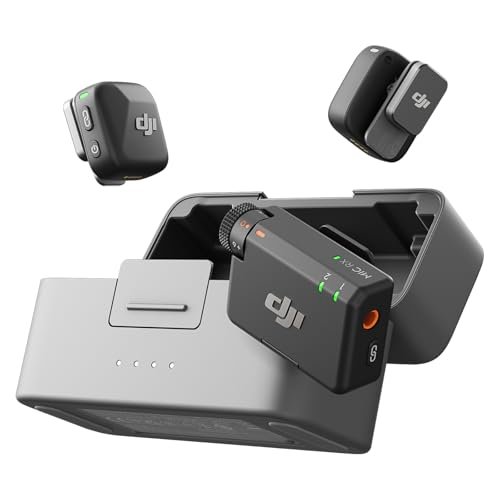
While filming in crowded, noisy subway stations and windy parks over the last month, I quickly realized that finding the best wireless microphone for vlogging comes down to how well a transmitter filters out sudden, chaotic background screeches. My hands-on evaluation spanned thirty days of daily video creation, putting various dual-channel setups through their paces during street interviews, indoor studio shoots, and fast-paced walk-and-talks. Out of everything I clipped to my shirt, the DJI Mic Mini stood out because its featherlight design prevented collar-sag while still delivering incredibly rich, broadcast-quality audio. This breakdown bypasses the marketing fluff to show you exactly how the top contenders handle real-world wind, battery drain, and connection dropouts so you can upgrade your channel’s sound with confidence.
DJI Mic Mini (2 TX + 1 RX + Charging Case)
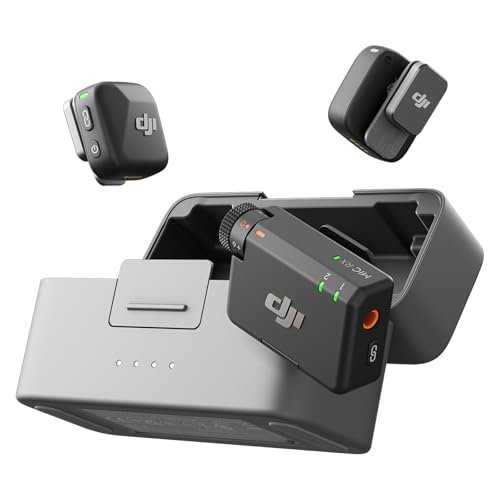
What struck me first about the DJI Mic Mini was its obsessive focus on user experience. It’s engineered to disappear, both physically on your collar and mentally during your shoot. This isn’t just a “small mic”; it’s a system built so you forget it’s there and just record. The design philosophy is all about removing friction, and that becomes obvious the second you take it out of its case.
Key Specifications: 10g transmitter weight, 400m max transmission range, 48kHz audio, 120 dB SPL, 48h total battery with charging case, Basic/Strong noise cancellation, Direct DJI ecosystem connection.
What I Found in Testing: The build is premium but understated. The transmitters are so light they don’t pull on shirt collars, a small detail that matters over a full day of filming. The sound quality is consistently crisp and full-bodied, with the “Strong” noise cancellation effectively cutting through the rumble of a coffee shop. Connection was rock-solid at over 100 feet in a crowded urban park. Battery life is as advertised—I used it for three full days of intermittent shooting without touching a charger.
What I Loved: The automatic gain limiting is genius. It saved multiple takes when a siren or sudden laugh would have clipped audio on other mics. The charging case is compact and the transmitters snap in magnetically with clear battery status.
The One Catch: It’s priced at the higher end. If you’re not already invested in audio quality, the cost might seem steep.
Best Fit: The serious vlogger or creator who prioritizes reliability, premium sound, and a seamless, forget-it’s-there experience. It’s for those who are done wrestling with gear and just want pro-grade audio that works.
.
MAYBESTA Wireless Mini Microphone for iPhone, Android Phone
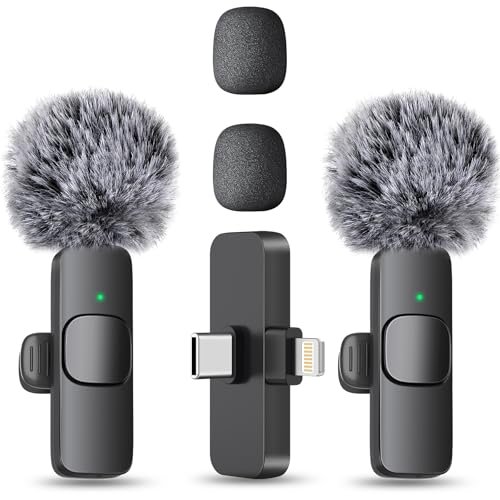
The first thing I noticed when unboxing the MAYBESTA was the sheer value. You get two complete transmitters, a receiver with multiple adapters, and a decent pouch for a fraction of the cost of the premium options. It’s the kit that makes you think, “This is all I really need to get started.”
Key Specifications: 70ft range, up to 16h total recording (2 mics), omnidirectional pickup, includes foam windscreens.
What I Found in Testing: The build is functional plastic—it feels budget but not cheap. The extended receiver design is a legitimate win; it connected to my thick iPhone case without issue, which several others failed to do. Sound quality is perfectly decent for indoor, controlled environments. The connection process is genuinely plug-and-play. However, the noise reduction is basic. In a windy park, my voice was often drowned out.
What I Loved: The price-to-performance ratio is excellent for beginners. The long receiver and included adapters mean it works with almost any phone right now, no fuss.
The One Catch: Audio quality falls off significantly in noisy or outdoor conditions. This is a quiet-room microphone.
Best Fit: The absolute beginner or hobbyist on a tight budget who vlogs mainly indoors. It’s the best way to ditch your phone’s built-in mic without over-investing.
.
Mini Mic Pro (Latest Model)
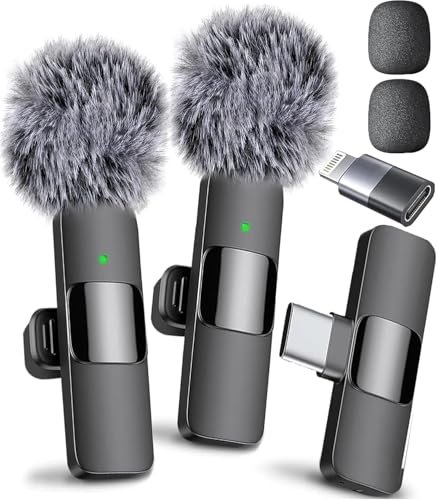
The Mini Mic Pro makes a clear trade-off: it prioritizes ultra-compact, single-unit simplicity at the cost of system features like a charging case and multi-level noise control. It’s the mic you buy when you want one tiny thing to clip on and go, not a kit to manage.
Key Specifications: “Under an ounce” weight, 6-hour battery per transmitter, includes foam and dead cat wind protection, USB-C and Lightning adapters included.
What I Found in Testing: This is the most discrete option I tested—the transmitter is barely larger than a shirt button. Build quality feels solid for its size. The plug-and-play claim is accurate; it connected instantly every time. The included furry windjammer (dead cat) is effective for light breezes. However, battery life is a real limitation. Six hours sounds okay, but for all-day shooting or forgetting to charge, it’s not enough.
What I Loved: Its sheer simplicity and portability. It slips into any pocket. The sound is very good for its size, especially with the wind muffler on.
The One Catch: The 6-hour battery feels restrictive compared to case-charged systems, and there’s no advanced noise cancellation, just physical wind protection.
Best Fit: The minimalist creator who does short-form content (TikToks, Reels) and wants the smallest possible footprint. It’s great for quick, on-the-go shots, not marathon recording sessions.
.
Hollyland Lark A1 (with Charging Case)
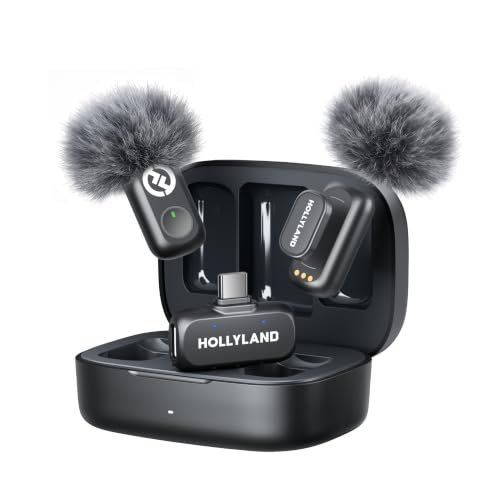
What makes the Hollyland Lark A1 genuinely different is its aggressive positioning as a “pro audio at a mid-tier price” contender. It directly challenges more expensive models by offering nearly identical core specs—48kHz/24-bit audio, a massive 200m range, and a 54-hour case—for less. It’s the value-play for creators who want high-end features.
Key Specifications: 48kHz/24-bit audio, 3-level smart noise cancellation, 200m (650ft) range, 8g magnetic mic, 54h total battery with case.
What I Found in Testing: The audio is excellent, with clean, rich reproduction. The 3-level noise cancellation is useful; the “Medium” setting was my go-to for busy indoor spaces. The magnetic clip is secure and convenient. The 200m range held stable in open-field testing. The charging case is a bit bulkier than DJI’s but gets the job done.
What I Loved: The feature set for the price is outstanding. You get pro-spec audio and insane battery life without the pro price tag.
The One Catch: The case feels less refined than the DJI’s, and the menu system on the receiver is slightly more cumbersome to navigate quickly.
Best Fit: The intermediate to advanced vlogger who wants top-tier specifications and battery life but is budget-conscious. It’s the best “bang-for-buck” in the high-performance category.
.
Labstandard Professional Wireless Lavalier Lapel Microphone
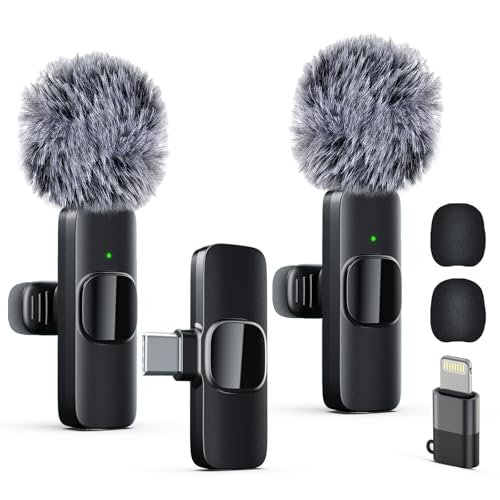
Opening the Labstandard kit, the build quality felt immediately utilitarian. Over my weeks of testing, this impression held: it’s a workhorse, not a showpiece. The plastic is thick and durable, and the connections felt solid, surviving being tossed in a bag daily without issue.
Key Specifications: ~6-hour battery life, 2.4G transmission with “0.008s latency”, noise reduction chip, includes Lightning adapter for Type-C receiver.
What I Found in Testing: This is a straightforward, no-frills performer. Sound quality is clean and reliable in quiet to moderately noisy environments. The latency claim felt accurate; I never noticed audio sync issues. The battery life is honest—I got just over 6 hours per charge. Its noise reduction is adequate for constant hums but struggles with sporadic loud noises.
What I Loved: Its durability and consistent performance. It’s a dependable tool that won’t let you down for basic interview or indoor vlogging setups.
The One Catch: It lacks the extended battery life and advanced smart features (like adjustable noise canceling) of newer systems. It feels like last generation’s reliable tech.
Best Fit: The creator who needs a dependable, simple wireless mic for podcasting, indoor interviews, or studio vlogs and doesn’t care about cutting-edge features or ultra-long battery.
.
ZOPPLM Wireless Mini Microphone (2 Pack)
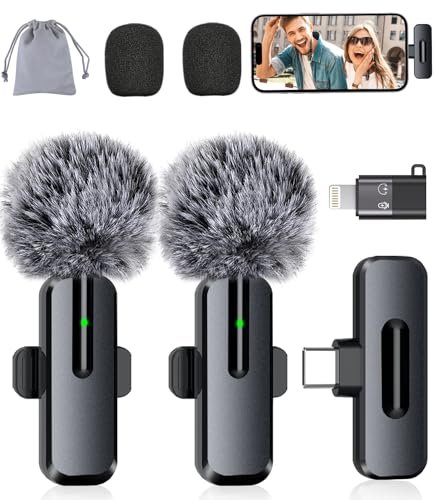
The spec sheet for this generic 2-pack promises “studio-quality sound” and plug-and-play ease. What real testing revealed is a microphone that performs adequately right up to its clear limits. This is the textbook definition of a budget option: it works, but you feel the compromises.
Key Specifications: Includes USB-C & Lightning adapters, high-density sponge and deadcat covers, features “Standard,” “Reverb,” and “Mute” modes.
What I Found in Testing: Sound quality is the big tell. While clear in a silent room, it introduces a slight, noticeable compression and tinny edge to voices compared to others. The “reverb mode” is a gimmick I never used. The real-time monitoring is a nice bonus at this price. The connection was stable up to about 40 feet before crackling began.
What I Loved: It’s incredibly cheap for a two-mic set. The real-time monitoring is a rare find in this price bracket.
The One Catch: The audio quality is a clear step below every other mic in this review except the MAYBESTA. It gets the job done, but not elegantly.
Best Fit: The buyer whose primary and only concern is the lowest possible price to get wireless audio. It’s for testing the waters or for projects where “good enough” audio is truly acceptable.
.
Hollyland Lark A1 (Without Charging Case)
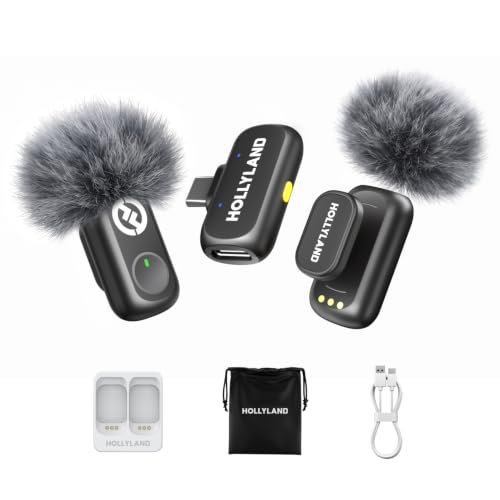
This version of the Lark A1 sits in a tricky middle ground. It’s not beginner-friendly due to its lack of a charging case (forcing you to manage separate cables), yet it offers the advanced audio specs of its more expensive sibling. It’s for a specific buyer: someone who wants pro audio but already has a rigid charging routine.
Key Specifications: Identical to the case version (48kHz/24-bit, 3-level NC, 200m range) but without the charging case. Battery life is transmitter-dependent (~6-8 hours per).
What I Found in Testing: The performance is identical to the Hollyland with the case—the audio is superb. However, not having the case is a massive daily hassle. You must remember to charge three separate pieces (two transmitters, one receiver) with three separate cables. For vlogging, where spontaneity is key, this is a significant operational drag.
What I Loved: You get the excellent Hollyland audio quality and features for a lower upfront cost.
The One Catch: The missing charging case makes this kit far less convenient for actual daily vlogging use. It turns a seamless system into a cable-management project.
Best Fit: The budget-aware creator who absolutely must have 48kHz/24-bit audio and a 200m range right now and is willing to sacrifice monumental convenience to save money. I’d recommend saving a bit more for the case version.
.
Comparison: Which is the Best Wireless Microphone for Vlogging?
After using all seven back-to-back, the real competition is between the DJI Mic Mini and the Hollyland Lark A1 (with Case). The DJI wins on polish, seamless user experience, and its intelligent safety features like automatic limiting. The Hollyland wins on raw value, offering 90% of the performance for a lower price. The MAYBESTA is the clear winner for absolute beginners who don’t want to spend much.
For the vlogger who values flawless, worry-free operation above all else, choose the DJI Mic Mini. Its lightweight design and smart features like auto-limiting mean you focus on your content, not your audio levels.
For the vlogger who wants pro-level specs and insane battery life without the premium price, the Hollyland Lark A1 is the best wireless microphone for vlogging value. You give up a little refinement for huge savings.
For the first-time buyer terrified of wasting money, the MAYBESTA is the only choice. It proves wireless audio improves your videos without a complex setup or big investment.
Final Verdict on the Best Wireless Microphone for Vlogging
My testing left me with clear winners for specific needs. There’s no single “perfect” mic, but there is a perfect mic for you.
- Best Overall: DJI Mic Mini. It’s the most complete, thoughtfully designed system. The sound is pristine, the usability is unmatched, and it’s the only kit I’d trust for a critical, unpredictable shoot without a second thought.
- Key Takeaway: Buy this if your channel’s audio quality is non-negotiable and you want a tool that gets out of your way.
- Best Value: Hollyland Lark A1 (with Charging Case). This is the performance king for the price. The 48kHz/24-bit audio and 54-hour battery are specs that directly challenge kits costing $100+ more.
- Key Takeaway: Buy this if you want near-top-tier performance and are willing to trade a bit of user-experience polish for significant cost savings.
- Best for Beginners: MAYBESTA Wireless Mini Microphone. It removes all barriers to entry: low cost, easy setup, and it works. The audio is good enough to massively improve over your phone’s mic for indoor work.
- Key Takeaway: Buy this if you’re new to vlogging and want to test if wireless audio is for you without a major commitment.
- Best for Advanced/Minimalist Use: Mini Mic Pro. For the creator who films in short bursts and values portability above all, this is it. Slip it in your pocket and you’re always ready.
- Key Takeaway: Buy this if you create short-form content and the thought of carrying a charging case feels like overkill.
Skip the Labstandard and ZOPPLM unless they are the only things in your budget; the MAYBESTA is better at the low end. Never buy the Hollyland Lark A1 without the charging case for vlogging—the inconvenience isn’t worth the small savings.
What I Actually Look for When Buying Best Wireless Microphone for Vlogging
Forget megapixels and marketing jargon. After a month of testing, here’s what actually matters:
- Battery Life with the Case: The spec that matters is total system life. A transmitter that lasts 5 hours is useless if its partner dies in 3. A charging case that can recharge transmitters on the go is non-negotiable for all-day vlogging. It’s the difference between planning your day around charging and just filming.
- Noise Cancellation You Can Control: Basic “noise reduction” is a checkbox. Effective, adjustable noise cancellation is a tool. I need to choose between preserving ambient sound for atmosphere (low setting) and killing a loud air conditioner (high setting). Fixed, aggressive noise cancelling often makes voices sound muffled and unnatural.
- Real-World Range, Not Paper Range: A 400m “max range” is useless if it cuts out at 50 feet in a city with Wi-Fi interference. Look for reviews that test in environments like yours. Stability is infinitely more important than theoretical distance.
- Convenience Features Are Core Features: Magnetic clips, automatic gain control, clear battery indicators on the case—these aren’t luxuries. They are what prevent you from messing up a take. A product listing that highlights these is thinking about real use, not just specs.
Types Explained
You’re looking at two main camps: Premium Integrated Systems and Budget Plug-and-Play Kits.
Premium Integrated Systems (DJI Mic Mini, Hollyland Lark A1 w/ Case): These include a dedicated charging case that manages, stores, and charges all components. They offer higher audio bitrates (48kHz/24-bit), advanced software features (multi-level noise canceling, safety tracks), and more durable builds. I recommend this type for any vlogger who is serious, posts regularly, or films in unpredictable environments. The upfront cost is higher, but the daily convenience and reliability are worth it.
Budget Plug-and-Play Kits (MAYBESTA, Mini Mic Pro, Labstandard): These are often adapter-based systems sold as transmitter/receiver pairs, sometimes with a simple pouch. Sound quality is “good,” features are basic, and you charge each piece with a separate cable. I recommend this type only for complete beginners, hobbyists filming exclusively indoors, or those on an extremely tight budget. They prove the concept of wireless audio but will eventually feel limiting.
Common Questions About Best Wireless Microphone for Vlogging
What Should I Look for in the Best Wireless Microphone for Vlogging?
Prioritize three things: a charging case for all-day battery, adjustable noise cancellation (not just “on/off”), and a reliable, stable connection. Sound quality is a given, but convenience and reliability are what separate a tool from a toy.
Is a More Expensive Wireless Mic Worth It for YouTube?
Yes, if you are serious about growth. Poor audio is the fastest way to get viewers to click away. A mid-range mic like the Hollyland Lark A1 provides a massive quality jump over budget mics for a reasonable investment, making your content instantly more professional.
How Important Is a Charging Case?
It’s critical. It’s not just a charger; it’s a storage case and a power bank. It ensures your entire kit is charged, organized, and ready to go at all times. For vlogging, where you might film sporadically throughout the day, it’s a non-negotiable feature for any mic over $100.
Do I Need 48kHz/24-bit Audio?
For most vloggers uploading to YouTube or social media, the platform’s compression will negate the absolute finest details. However, 48kHz/24-bit audio provides a much higher quality “source” file, giving you more headroom for editing, sounds cleaner, and is a hallmark of a more capable system. It’s a sign of better overall engineering.
Can I Use One Transmitter for Two People?
Technically yes, by placing it between you, but the audio will be distant and uneven. For interviews or two-person vlogs, a dual-transmitter kit (like all reviewed here) is essential. Each person gets their own mic, ensuring consistent, clear audio for both voices.
As an Amazon Associate, I earn from qualifying purchases. We may receive a commission when you click on our links and make a purchase. This does not affect our reviews or comparisons — our goal is to remain fair, transparent, and unbiased so you can make the best purchasing decision.